
15th February 2026
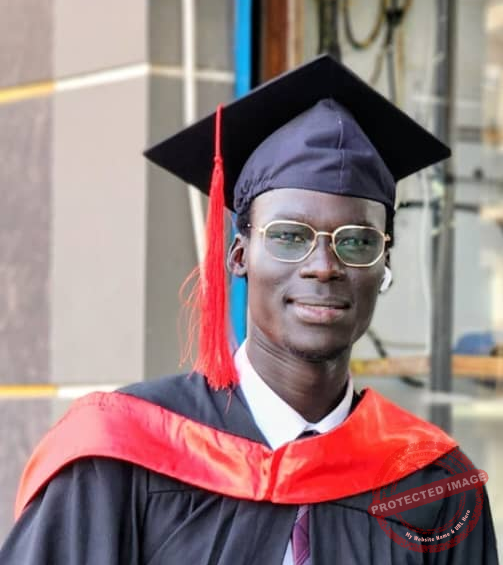
Mabile M. Jöthdít in his academic gown during his graduation at the University of Juba. The law graduate will head to the University of Oxford in 2026 as a Rhodes Scholar. — Courtesy: Mabile M. Jöthdít
JUBA, SOUTH SUDAN (Eye Radio) — Mabile M. Jöthdít is living proof that world-class excellence can be homegrown. A law graduate educated entirely within South Sudan, Mabile has defied the odds to be named a 2026 Rhodes Scholar. This September, he will trade the lecture halls of Juba for the historic spires of the University of Oxford, becoming one of the few students globally to secure the world’s most prestigious academic fellowship.
Mabile, a First Class Honours graduate of Law from the University of Juba (February 2025), has been selected for the 2026 Rhodes Scholarship, under the East Africa constituency. The award, widely regarded as the most prestigious postgraduate scholarship in the world, admits fewer than one percent of applicants globally.
Founded in 1903, the Rhodes Scholarship supports outstanding students to pursue postgraduate study at the University of Oxford. Each year, tens of thousands of applicants from more than 60 countries compete for just over 100 places.
For South Sudan, where access to global academic pathways is often assumed to require foreign schooling, the selection represents a quiet but consequential disruption.
The Rhodes Scholarship is not awarded on academic excellence alone. According to the Rhodes Trust, academic distinction is simply the baseline; all candidates are inherently expected to be capable of thriving at Oxford. What distinguishes successful applicants is a demanding combination of exceptional academic excellence, integrity of character, energy to make a difference, and capacity for leadership and public service.
“The Rhodes application was unequivocally the hardest test of my academic journey,” he says. “I spent three solid months in intense intellectual preparation—writing and deleting, reading, watching, and analysing everything about the scholarship and the University of Oxford.”
Applicants are required to articulate not only their academic plans but also a coherent vision of public purpose. The process includes multiple written submissions, institutional endorsements, and a final interview stage that is widely regarded as the most rigorous in global higher education.
“The criteria are multifaceted,” Mabile explains. “Intellectual prowess is just a bare minimum. Rhodes recognises that everyone who goes to Oxford is already a First Class Honours graduate. You are challenged to demonstrate leadership, talent, service, and character beyond the classroom.”
In East Africa, the competition is particularly intense. Tens of thousands of applicants are narrowed down through successive stages to a shortlist of just eight finalists, from whom only two scholars are ultimately selected.
When Mabile received his interview invitation, he already regarded the moment as an achievement in itself. “Very few applicants ever make the finalists’ list,” he says. “By the time I was invited, I was content with what I had accomplished.”
The final interviews, held over two days from October 31 to November 1, 2025, in Dar es Salaam, Tanzania, placed candidates before a panel of eleven senior Oxford academics and distinguished representatives of the Rhodes Trust.
The interviews are deliberately searching and probing, assessing candidates’ intellectual independence, ethical reasoning, and capacity to lead under pressure. “Sitting in front of that panel, I knew I was representing something bigger than myself,” Mabile reflects. “I was representing the underdogs of this world—students who have had to navigate conflict, instability, and scarcity to access education.”
Mabile’s election carries broader implications for how academic excellence is understood and recognised. His success challenges the assumption that elite knowledge is produced only within elite institutions.
“For many South Sudanese kids, the thought of going to Oxford is quite a self-defeating aspiration. To know that it is a possibility is frankly unfathomable but deeply humbling,” he says. “I hope this opportunity breaks the glass ceiling for locally educated South Sudanese scholars ”
He rejects the idea that intellectual authority must be imported.
“I don’t accept the notion that elite education can only be attained in Ivy League or top institutions,” he adds. “The quest for knowledge is not always an exclusive preserve of elite institutions. Quality education can come from anywhere.”
At Oxford, Mabile intends to pursue the Oxford BCL, notorious for its rigour, alongside an MSc in Criminology and Criminal Justice. His academic interests focus on Constitutional and Criminal law and post‑conflict governance, particularly how legal frameworks shape power, accountability, and democratic transition.
He intends to interrogate how peace agreements, like R-ARCSS, are weaponised in post-conflict states by elites to perpetuate impunity, defer elections, and rationalise violence. For students across South Sudan, his story offers not a promise of ease, but a demonstration of possibility, one grounded in discipline, preparation, and intellectual seriousness.
 1
1Published February 10, 2026
 2
2Published February 10, 2026
 3
3Published February 9, 2026
 4
4Published February 8, 2026
 5
5Published February 10, 2026
Published 15 hours ago
Published 16 hours ago

Published 17 hours ago
Published 18 hours ago

Published 22 hours ago
Published February 13, 2026
Support Eye Radio, the first independent radio broadcaster of news, information & entertainment in South Sudan.
Make a monthly or a one off contribution.
Copyright 2026. All rights reserved. Eye Radio is a product of Eye Media Limited.