
29th June 2026
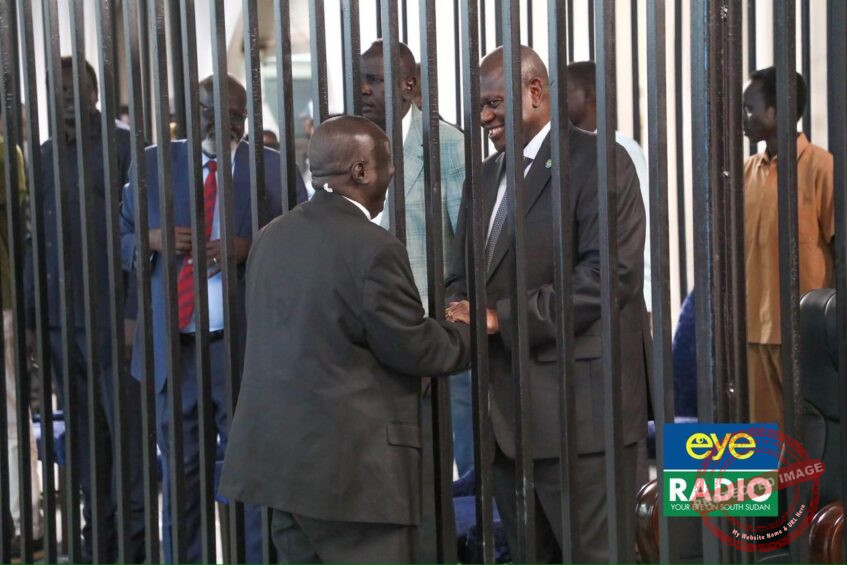
Defense lawyer Geri Raimondo greets his client, Dr Riek Machar, after the 4th session|Eye Radio
The special Court set to decide whether the remaining accused should be required to file written defence submissions, as requested by the prosecution as it postponed proceedings in the ongoing trial involving eight accused persons until Friday, 3 July, when the third accused will resume his defence.
The court is expected to rule on the prosecution’s application seeking written defence submissions from the remaining accused before hearing the continuation of the third accused’s testimony.
The prosecution in the trial involving suspended First Vice President Dr. Riek Machar and his co-accused has asked the court to require the remaining accused persons to submit their defence statements in writing, arguing that the move would speed up the proceedings.
During the 92nd session on 24th of June 2026, lead prosecutor Ajo Ohisa told the court that oral defence testimony had consumed considerable court time.
He argued that written submissions would reduce the time spent recording evidence and allow the court to hear witnesses more efficiently. He added that the request was intended to assist the court in managing the proceedings and was not meant to restrict the rights of the accused.
Defence lawyer Kur Lual Kur opposed the application, arguing that criminal trials require judges to hear directly from the accused and that written submissions should remain optional. The defence also maintained that the accused, who have been in detention for more than one year and three months, should be allowed to fully present their defence.
The court overruled a defence objection to the prosecution’s presentation of the application and directed the prosecution to summarise its arguments. The prosecution told the court it had informed the defence during the previous hearing that it intended to present the application and had requested a written response.
The court questioned whether the prosecution and defence had reached any agreement outside the courtroom regarding the application. It instructed both parties that all applications and responses must be presented before the court, stressing that it alone has the authority to determine such matters.
The court also observed that both the prosecution and the defence share responsibility for delays in the proceedings.
The court then invited the third accused, Gatwech Lam Pouch, to continue his defence.
In his testimony, Pouch challenged the prosecution’s digital forensic evidence, alleging that the prosecution had relied on an unqualified digital forensic expert in a case carrying potential penalties of death or life imprisonment.
He argued that the digital evidence presented against him was procedurally flawed, had not been properly verified, and therefore could not be relied upon. He further alleged that the prosecution’s digital forensic expert failed to properly examine and analyse the electronic exhibits presented before the court.
Pouch also questioned a telephone number cited by the prosecution, claiming it belonged to a member of parliament rather than to him. He argued that neither the prosecution nor the expert had established a link between the number and the allegations against him.
The accused further alleged that messages presented as evidence had been transferred from another source and inserted into his mobile phone.
He maintained that his phone had remained in the custody of the National Security Service from the date of his arrest on 11 March, making it possible, in his view, for information to have been added while the device was in official custody.
He also argued that investigators failed to specify the intelligence information he was accused of distributing or explain how he had allegedly provided material or financial support to armed youth groups.
Pouch challenged the prosecution over photographs, messages and an audio recording presented as evidence, arguing that the digital forensic expert had been unable to identify the speaker in the recording and that he himself did not know whose voice it was.
During his defence, Pouch cited a 1983 legal precedent involving two South Sudanese members of parliament who, according to his testimony, were arrested and transferred to Khartoum without prosecutorial authorisation or the lifting of parliamentary immunity. He argued that the charges in that case were dismissed because of procedural irregularities and insufficient evidence.
He also told the court that the prosecution had failed to establish the charge of common intention in relation to the Nasir incident under Section 48 of the South Sudan Penal Code Act, 2008.
The Special Court adjourned the proceedings until Friday, 3 July, when the third accused is expected to continue his defence testimony. The court will also deliver its ruling on the prosecution’s application seeking written defence submissions from the remaining accused.
Currently on air
19:30:00 - 20:00:00
 1
1Published June 28, 2026
 2
2Published June 25, 2026
 3
3Published June 23, 2026
 4
4Published June 23, 2026
 5
5Published June 24, 2026
 6
6Published June 23, 2026
 7
7Published June 24, 2026
 8
8Published June 27, 2026

Published 58 minutes ago

Published 2 hours ago

Published 2 hours ago

Published 2 hours ago

Support Eye Radio, the first independent radio broadcaster of news, information & entertainment in South Sudan.
Make a monthly or a one off contribution.
Copyright 2026. All rights reserved. Eye Radio is a product of Eye Media Limited.
