
17th August 2026
You are here: Home | National News | News | Prof. Nyaba blames militarized politics, backwardness for S. Sudan’s state-building failures
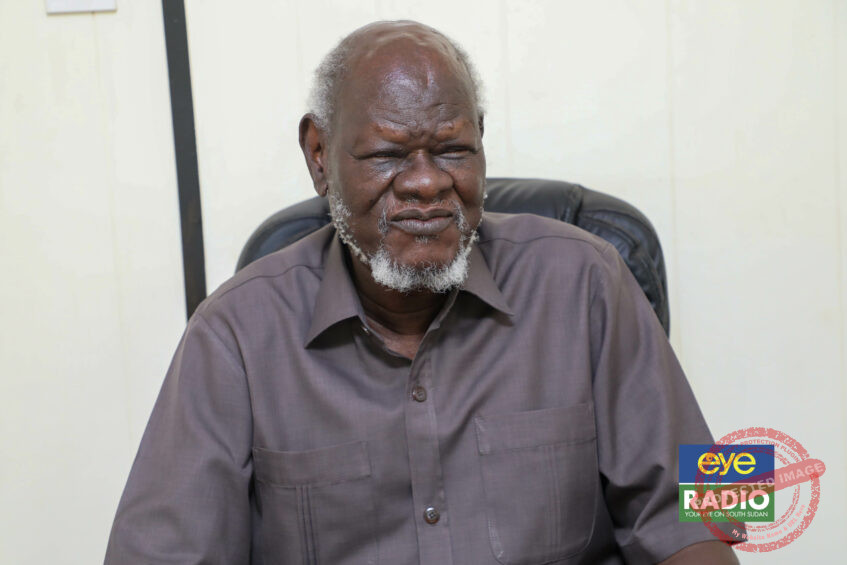
Professor Peter Adwok Nyaba during an interview with Eye Radio - Eye Radio/Moses Awan May 14, 2024
Veteran South Sudanese politician and academic Professor Adwok Nyaba says the country’s failure to build a functional state stems from the dominance of militarized politics and the absence of a clear political programme after the liberation struggle.
Speaking during a public discussion on South Sudan’s political transition, Nyaba said the country has failed to lay the foundations of a functioning state nearly two decades after the 2005 Comprehensive Peace Agreement.
“We have failed to build the state. We have failed to really put down the very basic thing,” Nyaba said.
He argued that South Sudan’s problems can be traced back to the formation of the Sudan People’s Liberation Movement and Sudan People’s Liberation Army as a combined political and military movement.
“When we talk about militarization and militarism, it’s because of the refusal to separate the political movement from the military movement,” he said.
“The SPLM, SPLA started as one thing… those who call themselves politicians in the SPLM are still military-minded. They don’t think politically; they think militarily. And I think this is the real problem.”
Nyaba said the liberation movement did not develop a political programme for governing the country after the war ended.
“The SPLM did not have a political program. Its only program was fighting the war. And when the war finished, we did not have any idea of what to do, what kind of a state we would want to build,” he said.
He also questioned the state of political pluralism in South Sudan, saying political parties have failed to distinguish themselves through clear ideological positions.
“We have more than 50 political parties… I don’t think there are any sharp ideological differences between these political parties,” Nyaba said.
He argued that political competition should focus on ideas and policies rather than the pursuit of power.
“The fundamental issue of South Sudan is not about power. Our real problem… was because we have the problem of poverty, problem of ignorance, and cultural backwardness,” he said.
“And until these issues of poverty, of ignorance, and cultural backwardness are addressed, they will still come back in another form.”
Nyaba called on political parties to develop clear policy platforms that address the country’s economic, social and governance challenges.
“Let each political party come up with these ideas. Let us compare these notes and see where we agree, and put them together, and build them up into a political program for running the country,” he said.
He warned that unless political leaders move away from militarized politics and embrace genuine political dialogue, South Sudan risks repeating cycles of instability as it prepares for future elections.

Currently on air
00:00:00 - 06:00:00
 1
1Published August 10, 2026
 2
2Published August 10, 2026
 3
3Published 17 hours ago
 4
4Published 15 hours ago
 5
5Published August 11, 2026
 6
6Published August 12, 2026
 7
7Published August 10, 2026
 8
8Published August 10, 2026
Published 15 hours ago
Published 17 hours ago

Published 18 hours ago
Published August 15, 2026
Published August 15, 2026

Published August 15, 2026
Support Eye Radio, the first independent radio broadcaster of news, information & entertainment in South Sudan.
Make a monthly or a one off contribution.
Copyright 2026. All rights reserved. Eye Radio is a product of Eye Media Limited.