
17th August 2026
You are here: Home | National News | News | Parliament | Peace | Politics | Peace deal amendments: Inside controversial R-ARCSS changes ahead of elections
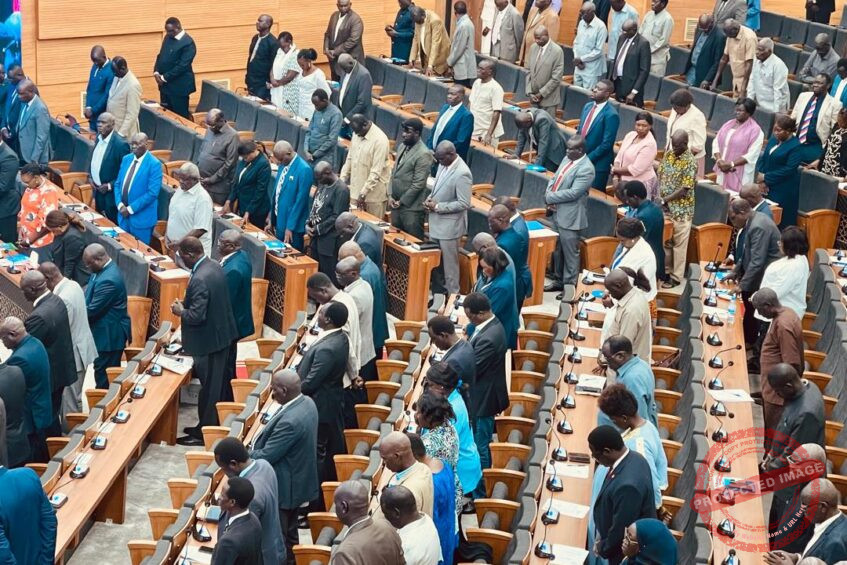
Lawmakers stand during a parliamentary sitting. Photo: Wol Mapal/Eye Radio.
Opposition lawmakers on Monday walked out of Parliament, protesting what they describe as violations of the peace agreement. The proponents of the amendments, however, argue that the proposed changes will help pave the way for the conduct of general elections in December this year.
During the sitting, Parliament received proposed amendments to the Revitalized Agreement on the Resolution of the Conflict in South Sudan (R-ARCSS), affecting three chapters and Annex D of the peace deal, in what the government says is aimed at preparing for the upcoming elections.
But members of the Sudan People’s Liberation Movement-in-Opposition (SPLM-IO) stormed out of the August House, saying the procedures were flawed and lacked endorsement from all parties to the peace agreement. They also said the SPLM-IO was not consulted or fully involved in the process, which they argue contravenes the provisions of the R-ARCSS.
The proposals were presented before the August House by the Minister of Justice and Constitutional Affairs, Justice Michael Makuei Lueth on Monday.
So, what will change and why?
In the explanatory note attached to the amendments, the government says the changes are intended to separate the permanent constitution-making process and the national population and housing census from the conduct of elections.
Makuei told lawmakers that the amendments are meant to pave the way for “free, fair, credible and democratic elections” and allow citizens to elect their leaders.
The document outlines 10 proposed changes affecting Chapter I, Chapter VI, Chapter VIII, and Annex D of the agreement.
At the centre of the proposals is a change to provisions that previously required the permanent constitution-making process to be completed before the end of the transitional period.
The amendment to Article 1.2.5 now states that the RTGoNU shall instead ensure amendment of the Transitional Constitution of South Sudan, 2011, to delink it from the permanent constitution-making process.
Another key proposal removes the requirement for a national population and housing census to be conducted before the end of the transitional period.
Instead, it states that “the elected government shall conduct a national population and housing census,” although the document also suggests deleting the provision as redundant.
The amendments also propose changes to election timelines, including reducing the period for publishing the voters’ register from six months to three months before elections.
In Chapter VI, Article 6.4, which requires the permanent constitution to be completed within 24 months of the transitional period and guide elections, is proposed for deletion.
The government is also seeking to remove provisions in Chapter VIII that establish the supremacy of the R-ARCSS over conflicting national laws and constitutional provisions.
Chapter VIII would also be renamed from “Supremacy of this Agreement and Procedures for Amendment of the Agreement” to simply “Procedures for Amendment of the Agreement.”
The changes extend to Annex D on the National Elections Act, where references to the “Permanent Constitution” would be replaced with the “Transitional Constitution of the Republic of South Sudan, 2011 (as amended),” and electoral preparation timelines reduced from six months to three months.
In the explanatory note, Makuei said the amendments were unanimously endorsed by the Council of Ministers and are meant to avoid delays in key election preparations.
However, the debate ended in tension as SPLM-IO lawmakers walked out in protest, saying the proposed changes violate the 2018 peace agreement.

Currently on air
00:00:00 - 06:00:00
 1
1Published August 10, 2026
 2
2Published August 10, 2026
 3
3Published 18 hours ago
 4
4Published 16 hours ago
 5
5Published August 11, 2026
 6
6Published August 12, 2026
 7
7Published August 10, 2026
 8
8Published August 10, 2026
Published 16 hours ago
Published 18 hours ago

Published 19 hours ago
Published August 15, 2026
Published August 15, 2026

Published August 15, 2026
Support Eye Radio, the first independent radio broadcaster of news, information & entertainment in South Sudan.
Make a monthly or a one off contribution.
Copyright 2026. All rights reserved. Eye Radio is a product of Eye Media Limited.