
17th August 2026
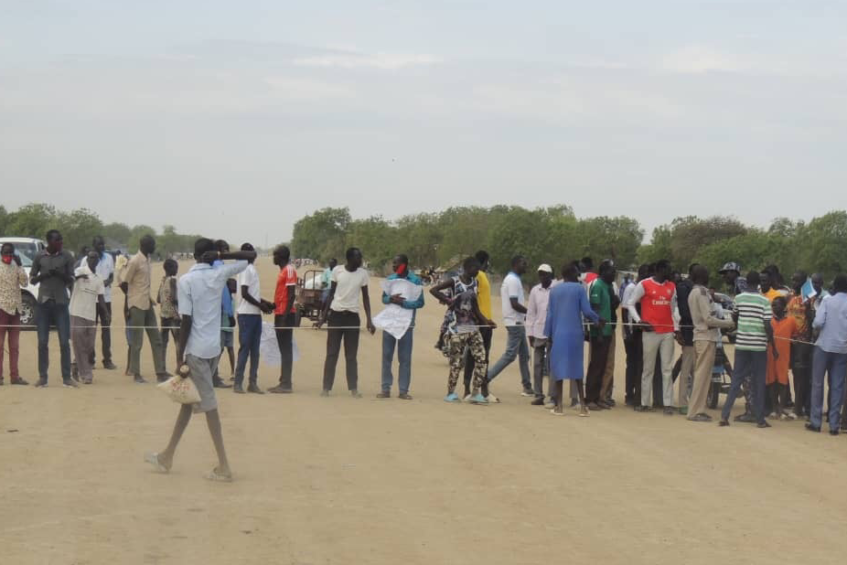
Some of the striking civil servants in Bor town who blocked Airport road on Tuesday December 21, 2021 - courtesy
As official celebrations for International Workers’ Day approach, thousands of public employees face delayed salaries and a lack of necessities. This raises pressing questions about social justice and the credibility of honoring workers amid a deepening livelihood crisis.
As the Government of South Sudan prepares to mark International Workers’ Day on May 1, a profound contradiction emerges between official rhetoric and the lived reality of thousands of public servants.
While slogans praise the role of workers in nation-building, stability, and development, many endure extremely harsh conditions due to prolonged salary delays—stretching for months and, in some cases, years.
According to a report by Eye Radio, the Minister of Labor and Public Service, Hon. Anthony Lino Makana, announced that South Sudan will host its inaugural national celebration of International Workers’ Day on May 1, 2026.
The event, to be held at Juba National Stadium under the theme “Empowering Workers, Developing South Sudan,” is expected to bring together government officials, trade unions, and international partners.
Yet, for the many workers who remain unpaid, this ambitious theme stands in stark contrast to their daily reality. It raises a deeper concern: can “empowerment” truly be proclaimed without first ensuring economic justice?
This contradiction prompts a fundamental question: how can workers be celebrated while being deprived of their wages? Furthermore, how can an official celebration reflect genuine appreciation when workers cannot provide basic needs—such as food, healthcare, and education—for their children?
The crisis of delayed salaries is more than an administrative or financial lapse; it strikes at the core of social justice and human rights. Wages are not a privilege or a favor—they are a legal and moral right earned through labor.
This right is clearly enshrined in international legal frameworks, beginning with Article 23(3) of the Universal Declaration of Human Rights, which affirms that every worker has the right to just and favorable remuneration ensuring a life of dignity.
This is further supported by the International Covenant on Economic, Social and Cultural Rights, where Articles 7 and 8 guarantee fair working conditions, equitable wages, and the right to strike as a legitimate means of defense.
Additionally, International Labour Organization Conventions No. 87 and No. 98 safeguard freedom of association and protect workers from discrimination or retaliation for trade union activities.
At the regional and national levels, the African Charter on Human and Peoples’ Rights, the Transitional Constitution of South Sudan (2011), and the Labour Act (2017) all establish a clear legal basis for fair wages and labor rights. Yet, the gap between these legal provisions and actual practice remains wide and deeply troubling.
Beyond the law, moral and religious teachings strongly affirm the necessity of timely payment. The Bible states in Deuteronomy 24:15 that wages should be paid each day before sunset, establishing a clear link between work and prompt compensation.
Similarly, James 5:4 warns against withholding wages, emphasizing that such injustice “cries out” and stands condemned both morally and spiritually.
In light of these realities, celebrating Labour Day without addressing the root causes of the wage crisis risks becoming a symbolic gesture—or worse, a display of disconnect from the people’s suffering.
Honoring workers is not achieved through speeches, but through policies that ensure a dignified life. If the celebration is to carry real meaning, several concrete steps must be taken immediately.
The government must first oversee the immediate settlement of all outstanding salary arrears or, at minimum, implement a binding payment timeline before May 1.
This should be accompanied by a comprehensive review of the wage structure to reflect the rising cost of living, alongside the guaranteed protection of trade unions to engage in collective bargaining without fear of retaliation.
Furthermore, an independent oversight mechanism is required to monitor salary payments and enforce labor laws, while a genuine national dialogue must be initiated between the government and civil society to find a sustainable solution to this crisis.
Ultimately, Labour Day should be redefined as a moment of accountability and measurable progress rather than a ceremonial event detached from reality.
The success of any celebration will not be measured by the size of the crowd or the eloquence of the speeches, but by whether the workers of South Sudan can live with dignity, receive their wages on time, and exercise their rights without fear.
Editor’s note: The views in this article are the author’s own and do not necessarily reflect Eye Radio’s editorial stance.
About the Author: William Sunday D. Tor is a Human Rights activist and the former Chairperson for the Justice and Peace Committee at Sts. Peter & Paul Parish, Catholic Archdiocese of Khartoum. He is currently a Lecturer in Security Studies, International Development, and Regional Planning at Starford International University, Juba. He can be reached at: williamtor2011@gmail.com.

Currently on air
00:00:00 - 06:00:00
 1
1Published August 10, 2026
 2
2Published August 10, 2026
 3
3Published 17 hours ago
 4
4Published 15 hours ago
 5
5Published August 11, 2026
 6
6Published August 12, 2026
 7
7Published August 10, 2026
 8
8Published August 10, 2026
Published 15 hours ago
Published 17 hours ago

Published 18 hours ago

Published August 15, 2026

Published August 15, 2026

Published August 15, 2026
Support Eye Radio, the first independent radio broadcaster of news, information & entertainment in South Sudan.
Make a monthly or a one off contribution.
Copyright 2026. All rights reserved. Eye Radio is a product of Eye Media Limited.