
1st July 2026
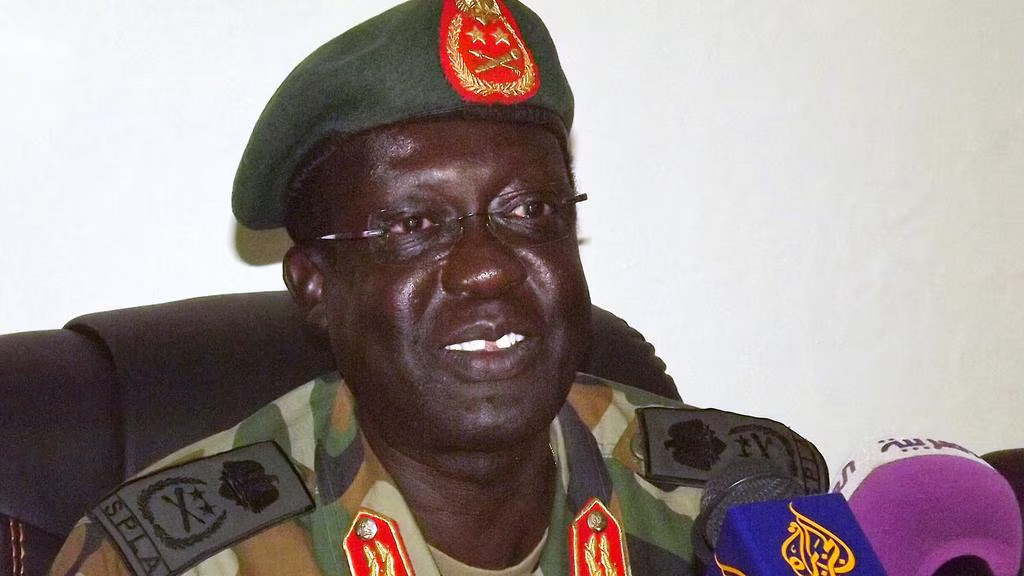
Former Sudan People's Liberation Army (SPLA now SSPDF) Chief of Staff General James Hoth Mai in 2014. Picture: AFP
South Sudan gained her independence from Sudan on 9th July 2011 after decades of armed struggle and sacrifices made by her dedicated sons and daughters. However, it is worth noting that the quest for freedom and self-determination did not begin in recent history alone.
The people of South Sudan had resisted oppression since the period of Turkish rule (1821-1881), the Mahdist rule (1881-1885), the Anglo-Egyptian rule (1885-1956) passing through different stages of struggle, including colonial and post-colonial periods, until the mighty Sudan People’s Liberation Army (SPLA) put the oppression to an end by attaining the independence of the Republic of South Sudan on 9th July 2011.
This long and tedious journey was marked by resilience, courage, and unwavering determination by generations of South Sudanese who fought for justice, dignity, and the right to govern themselves.
The people of South Sudan contributed immensely to the liberation struggle, particularly during the periods from 1955-1972 (Anya Anya One), 1975-1982 (Anya Anya Two) and from 1983 to 2005 (SPLA-SPLM), ending with the signing of the CPA in Naivasha, Kenya, in January 2005.
The One of the major contributions was through extraordinary sacrifices made by families and communities across the country and diaspora. Thousands of parents allowed their sons and daughters to join and participated in the formation of the Sudan People’s Liberation Movement/Army in 1983 leaving behind their lovely families, education, livelihoods, and personal dreams. Some never returned; others carried physical and emotional scars.
The second contribution made by South Sudanese was when communities generously provided food and other necessities to thousands of fighters graduating from training centres.
The third contribution was that many civilians, with various backgrounds, played critical roles in transporting ammunition, supplies, and equipment to different parts of South Sudan, as well as to areas such as Southern Kordofan and Southern Blue Nile, despite enormous risks to their lives and livelihoods.
These sacrifices should never be forgotten; they rather be treasured in the history of the struggle. The people of South Sudan deserve meaningful dividends of peace and liberation from the SPLM – led government. This includes the provision of quality education through schools, accessible healthcare through hospitals, clean drinking water, building modern road infrastructure, decent employment opportunities for the youth, and lasting peace, security, and stability across the country.
Honouring the sacrifices of the people of South Sudan means improving their living conditions, ensuring that the benefits of independence are felt and enjoyed by all citizens.
“The extraordinary sacrifices of South Sudanese families and civilians—who gave up their children, provided food, and transported supplies at great personal risk—must never be forgotten, and the best way to honor this legacy is for the government to deliver the true dividends of peace by improving the living conditions of all citizens.”
Why must the people of South Sudan celebrate 16th May?
The celebration of 16th May, SPLA DAY, South Sudan People’s Defence Forces (SSPDF) DAY, is important to the people of South Sudan because it commemorates the beginning of the last phase of the armed struggle, which culminated in the birth of the Republic of South Sudan.
On 16th May 1983, the soldiers, political leaders, students, and civilians, who later in July 1983 formed the Sudan People’s Liberation Movement/ Sudan People’s Liberation Army, launched in Bor Town the armed struggle against marginalization and injustice in Sudan. For many South Sudanese, this date symbolizes sacrifices, resilience, unity, and the struggle for self-determination. The reasons are as follows:
Honouring the Sacrifices of Heroes and Heroines.
Following years of dissatisfaction among South Sudanese after the signing of the Addis Ababa Agreement in 1972, tensions steadily increased due to the failure of the Khartoum regime to implement the agreement in both letter and spirit. The agreement that brought an end to the first civil war was gradually undermined by political and socio-economic domination from the North over the South.
By the end of 1982 and mid 1983, the anger and disappointment of southerners had reached its peak. Men and women answered the call of duty to continue the liberation struggle and complete what AnyaNya one had not fully accomplished.
The situation escalated after the government in Juba attacked Battalion 105th stationed in Bor, accusing the senior officers of embezzling money meant for the soldiers’ salaries, which was not true; the truth was in the disappointment of southerners mentioned above. This marked the turning point that pushed many soldiers, politicians, students, and civilians to take up arms and retreat to the bush. The call in Bor in May 1983 was echoed in Ayod, Pibor, Wangkei, and other towns in South Sudan in the same month.
The formation of the SPLM/SPLA, particularly between July and September 1983, was not easy. It passed through difficult stages and internal disagreements, including armed confrontations with some factions of Anya nya Two, who refused to join hands with other elements to form a new united movement. Despite these challenges, unity gradually prevailed, laying the foundation for a movement that would later shape the destiny of South Sudan.
Because of that, the May 16th day is dedicated to remembering the men and women who sacrificed their precious lives during the formation of the liberation struggle.
It recognizes, millions of Martyrs who died for freedom of the people of South Sudan, wounded veterans who survived the war and are still committed to the principles and values of the revolutionary, widows and orphans who continue to endure hardships and loss of their dear ones, and civilians who suffered displacement, hunger, and insecurity.
Indeed, 16 May is a moment in our lives, as witnesses to the revolution, to pay tribute to those whose sacrifices contributed to the birth of South Sudan.
Remembering the History of Liberation
The history of the struggle in South Sudan can be traced back to the 1940s, when South Sudanese began demanding a federal system of governance that would guarantee autonomy, equality, and fair political representation within Sudan. During this long journey of struggle, prominent political and military leaders led the struggle, and their names are written in our history. To remember them is an obligation that the current generation must cherish.
However, these aspirations were not met, leading to growing tensions between the North and the South. The North- South armed conflict officially began on 18th August 1955 with the Torit mutiny, which erupted before Sudan attained its independence in January 1956.
South Sudanese soldiers in Torit rebelled against the central government due to fear of political marginalization and domination by the North. The Torit mutiny marked the beginning of the first phase of the armed struggle, which later developed into the Anyanya one movement and continued until the signing of the Addis Ababa Agreement in 1972.
The second phase of the armed struggle began on 16th May 1983 in Bor, following the mutiny of the 105th Battalion. This phase gave birth to the Sudan People’s Liberation Movement and the Sudan People’s Liberation Army (SPLM/SPLA), which emerged to continue the struggle against the political, economic, and social marginalization of South Sudan by the North. The struggle eventually culminated in the independence of South Sudan on 9th July 2011.
Celebrating 16th May reminds younger generations about the history of the liberation struggle and the reasons why the movement began in 1983. It helps preserve national memory and teaches citizens about, the fight against oppression and inequality, the long journey toward peace and self-determination, and the values of courage, patriotism, and perseverance. Without remembering history, future generations may not understand the price paid for independence.
Celebrating National Identity and Independence
The celebration of 16th May strengthens national pride and identity among the people of South Sudan. It reminds South Sudanese that independence was not achieved easily, but through decades of struggle, sacrifices, resilience, and determination by countless men and women who dedicated their lives to the liberation of the country.
It also reminds the veterans and the generations to come through revolutionary songs how the struggle was carried out and achieved. Most importantly, people from different social backgrounds fought together and achieved the objectives of the struggle.
The day serves as a reminder that freedom comes with responsibilities. It’s calling on the citizens to honour the sacrifices of heroes and heroines by working together to build, protect, and develop the nation. It reinforces the spirit of unity, patriotism, and collective responsibility, encouraging South Sudanese to put aside divisions and work together as one people, one nation, toward peace, stability, and prosperity for future generations.
Recognizing the Role of the Armed Forces
The 16th May celebration acknowledges the transformation of the Sudan People’s Liberation Army ( SPLA) into the South Sudan People’s Defend Forces (SSPDF). The decision by the leadership and the people of South Sudan to hand over the SPLA, which was up to 2017, the national army, to the people of South Sudan was a testament that the SPLA had indeed accomplished its objectives of liberation.
The occasion also recognizes the efforts carried out by different chiefs of staff and chiefs of defence forces, since 1984 to date, in modernizing the force into a formidable national army, whose mandate is to protect the sovereignty and territorial integrity of South Sudan, while safeguarding its people and their properties.
Promoting Unity and Reconciliation
The SPLA Day, today celebrated as SSPDF Day, serves as an important opportunity for South Sudanese from different communities, ethnic groups, and backgrounds to reflect on their shared history of struggle, unity, sacrifices, and aspirations for a better nation. It reminds citizens of the collective efforts made during the liberation struggle and the price paid together as one people for freedom and independence.
The event celebrations also strengthens commitment to peace, unity, reconciliation, and national development. It encourages South Sudanese to embrace diversity, overcome divisions, and work together in the spirit of nation-building.
By reflecting on the lessons of the past, the celebration inspires citizens to renew their unwavering commitment to protecting the hard-earned peace and contributing positively to the progress and prosperity of South Sudan.
Inspiring Patriotism and Responsibility
For many citizens, especially the youth, the celebration serves as an important reminder that nation-building requires commitment, discipline, patriotism, hard work, and unity. It teaches younger generations that the freedom and independence enjoyed today came at a great cost through the sacrifices of brave men and women during the liberation struggle. These sacrifices inspire citizens to contribute fairly toward the country’s future and to play an active role in building a peaceful, stable, and prosperous South Sudan.
Conclusion
In conclusion, 16th May is worth celebrating because it reminds us of the enormous sacrifices made during the liberation struggle. Millions of South Sudanese lost their lives, thousands of mothers were widowed, and countless children were left orphaned. Many of our brave sons and daughters sustained life-changing injuries, losing their legs, arms, eyesight, and other parts of their bodies in pursuit of freedom and dignity for our people.
As we commemorate this historic day, we must reflect not only on the painful sacrifices of our heroes and heroines, but also on the achievements realised through their struggle.
The best way to honour their legacy is to cement peace, unity, and national cohesion among ourselves. We must reject tribalism, hatred, division, corruption, and all forms of anti-development practices that hinder our progress as a nation. Together, united as one people, we can build a peaceful, prosperous, and stronger South Sudan worthy of the sacrifices made for our independence.
Currently on air
13:30:00 - 14:00:00
 1
1Published June 28, 2026
 2
2Published June 25, 2026
 3
3Published June 30, 2026
 4
4Published June 29, 2026
 5
5Published June 29, 2026
 6
6Published June 24, 2026
 7
7 8
8Published June 29, 2026
Published 22 minutes ago

Published 42 minutes ago

Published 1 hour ago

Published 2 hours ago

Published 2 hours ago
Support Eye Radio, the first independent radio broadcaster of news, information & entertainment in South Sudan.
Make a monthly or a one off contribution.
Copyright 2026. All rights reserved. Eye Radio is a product of Eye Media Limited.