
11th June 2026
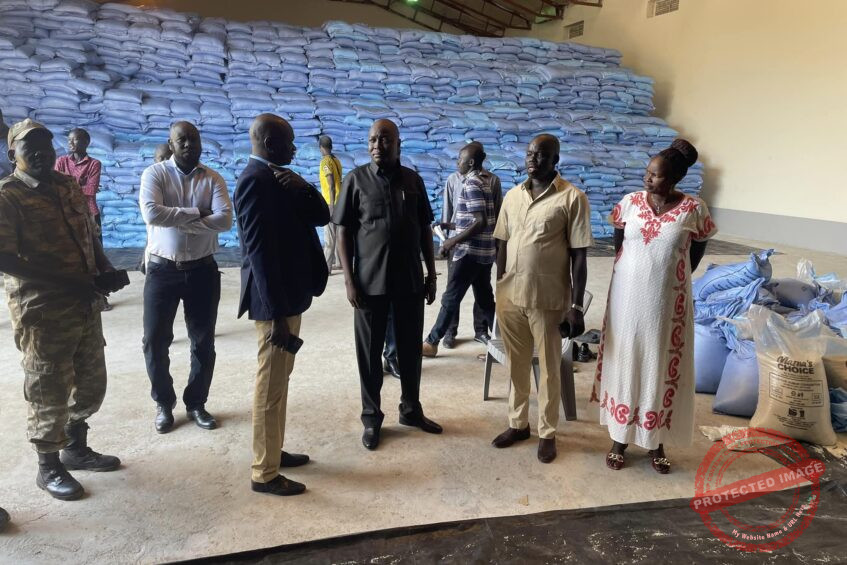
NBG Governor Simon Ober assess food commodities at a store in Juba. (Photo: NBGs Governor's office/Facebook).
The Northern Bahr el Ghazal government said it is shipping 4,000 bags of food commodities from Juba to Aweil to be sold at subsidized prices as a short-term solution to ease the dire economic hardships.
NBGs Governor Simon Ober Mawut oversaw the loading of trucks with the tons of subsidized assorted food commodities destined for the state to force traders to lower skyrocketing prices as the pound currency continues to depreciate.
“This initiative aims to stabilize market prices and provide the public with access to affordable food, particularly essential items, to help reduce poverty and improve living standards,” the governor’s office said in a statement.
It was indicated that the food consignment will be transported once arrangements are finalized and will be sold at prices 50% lower than the market rate for similar goods.
The governor’s office added that some of the food supplies will be distributed free of charge to those severely affected by the ongoing torrential floods in the state, helping to alleviate hunger among flood victims.
In July, neighboring Warrap State procured and distributed around 10,000 bags of assorted food commodities to local markets in Kuajok and the six counties at a subsidized price.
Warrap Information Minister William Wol Mayoum said one 50 kg bag of maize flour was to be sold at 95,000 South Sudan pounds, and a bag of sorghum of the same weight will be sold at 70,000 SSP.
This was less than the current prices at Kuajok market, where a 50-kg bag of maize flour costs 120,000 SSP while a 50-kg bag of sorghum is sold at 85,000 SSP.
South Sudanese are struggling to put food on the table as a result of multiple crises, including a catastrophic inflation attributed to the rupture of a pipeline transporting crude oil through war-torn Sudan to the Red Sea.
This has left the pound currency losing 70 percent of its value since January 2024, and civil servants and members of the organized forces have not been paid for nearly 10 months.
The economic relief initiative of importing subsidized food, widely embraced by the government, has been criticized by an economist who suggested that the only way to ultimately beat inflation is by providing a stable environment and boosting agriculture.
Dr. Abraham Maliet said in March 2024 the purchase of food items is a drop in the ocean, due to the worsening economic downturn, while recommending the procurement of farming tools and equipment to support agricultural production.

Currently on air
00:00:00 - 06:00:00
 1
1Published June 5, 2026
 2
2Published June 8, 2026
 3
3Published June 5, 2026
 4
4Published June 5, 2026
 5
5Published June 8, 2026
 6
6Published June 9, 2026
 7
7 8
8Published June 9, 2026

Published 9 hours ago

Published 9 hours ago

Published 9 hours ago

Published 12 hours ago

Published 12 hours ago

Published 13 hours ago
Support Eye Radio, the first independent radio broadcaster of news, information & entertainment in South Sudan.
Make a monthly or a one off contribution.
Copyright 2026. All rights reserved. Eye Radio is a product of Eye Media Limited.