
30th August 2026
You are here: Home | News | Regional News | Security | “Ilemi Triangle not part of Kenya.” VP Taban rejects maps annexing border area
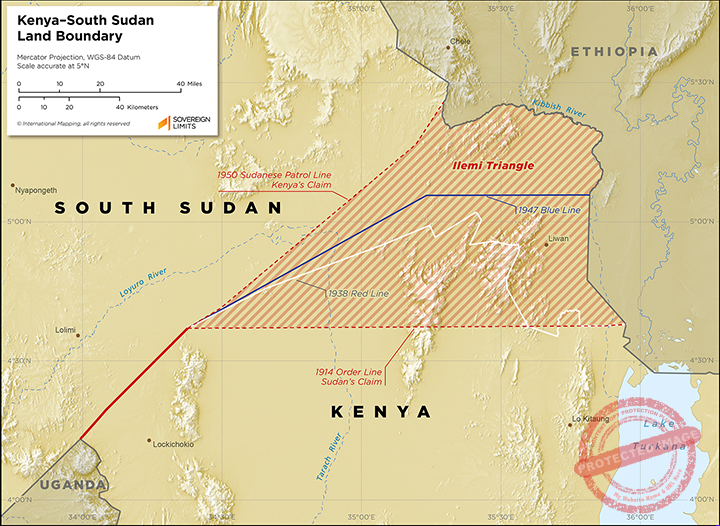
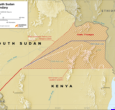
llemi Triangle Map - courtesy
Vice President Taban Deng Gai has called for the contested Ilemi Triangle to be formally designated as a zone of discussion, cautioning against regional map representations that depict the border territory as part of Kenya.
Speaking during the 7th edition of the Global Logistics Convention in Juba, Vice President Taban raised concerns over regional cartographic representations displaying East African borders.
Pointing to the southern tip of South Sudan’s national map, Vice President Taban questioned geographic depictions that incorporate the Ilemi Triangle into Kenyan territory, reiterating that the border area remains legally open to bilateral negotiations.
“That one is not the map of South Sudan,” Vice President Taban told delegates. “This Ilemi Triangle should be seen always as a place of discussion. It’s not part of Kenya.”
He recounted historical political developments surrounding the territory, referencing domestic political debates in Kenya during the administration of former President Daniel arap Moi and opposition figures regarding the status of the border area.
Addressing the nomenclature of the disputed zone, Vice President Taban noted that the term “Ilemi” traces its origins to an indigenous chief, Chief Ilemi, who historically settled the locality. He explained that previous administrative arrangements led to Kenyan authorities overseeing the remote territory due to logistical distances from Kapoeta and Khartoum.
“Because Ilemi was very far from Kapoeta and from Khartoum, Kenyans were asked to administer it on behalf of us,” he stated, noting that the historic arrangement was administrative rather than a transfer of sovereignty.
Vice President Taban urged organizers and regional stakeholders to accurately annotate international maps presented at public and diplomatic forums, emphasizing that the Ilemi Triangle must be distinctly marked as a subject of ongoing bilateral border discussions.
Kenya and South Sudan share a straight-line border that extends for over 200 km from the tripoint with Uganda in the south to the tripoint with Ethiopia in the north or east. Over two-thirds of its length is in dispute, making up an area known as the Ilemi Triangle.
The conflict stems from ill-defined British colonial boundaries, and the disputed area was originally between the British colony of Uganda and the Anglo–Egyptian Condominium of Sudan.
The Ugandan Rudolf Province was transferred to Kenya Colony in 1926, and the remote and poorly delineated Ilemi Triangle went with it. South Sudan inherited the dispute from Sudan after its independence in 2011.
The Ilemi Triangle has historically been divided by a variety of survey, patrol, and administrative lines throughout the colonial period, many of which are known by the color on which they appeared on maps of the era. The initial, vague international boundary defined between Uganda and Sudan in 1914 still characterizes South Sudan’s claim to the Ilemi Triangle.
Kenya maintains de facto control of the entire area, all the way up to what is known as the 1950 Sudanese Patrol Line. Between these two extremes, there are at least two other commonly mapped “boundary” lines known as the 1938 Red Line and 1947 Blue Line, both of which were established under British oversight to better demarcate the grazing grounds of the Kenyan Turkana pastoralist peoples to which the original 1914 border vaguely referenced.
Instability and lack of resources have characterized the failure of a resolution to the Kenya–South Sudan boundary dispute. There were attempts during the colonial era to settle the territorial conflict, but solutions were almost impossible to implement due to the broader geopolitical picture.
In the 20th century, the dispute involved not only Kenya, Sudan, and the UK, but also Uganda, whose nomadic peoples utilized the Ilemi Triangle, and Ethiopia, an independent empire with its own territorial aspirations, and Egypt, who had partial control of Sudan.
Today, the dispute involves Kenya, South Sudan, and Ethiopia, but regional conflict, the importance of maintaining territory, and the possibility of natural resources present in remote Ilemi, have continued to make the dispute difficult to resolve.

Currently on air
14:00:00 - 16:00:00
 1
1Published August 24, 2026
 2
2Published August 29, 2026
 3
3Published August 24, 2026
 4
4Published August 25, 2026
 5
5Published August 28, 2026
 6
6Published August 25, 2026
 7
7 8
8Published August 28, 2026

Published 37 minutes ago
Published 1 hour ago
Published 2 hours ago

Published 2 hours ago
Published 2 hours ago

Published August 29, 2026
Support Eye Radio, the first independent radio broadcaster of news, information & entertainment in South Sudan.
Make a monthly or a one off contribution.
Copyright 2026. All rights reserved. Eye Radio is a product of Eye Media Limited.