
25th August 2026
You are here: Home | Governance | News | Environment Minister criticizes lack of climate finance, warns of delays in national projects
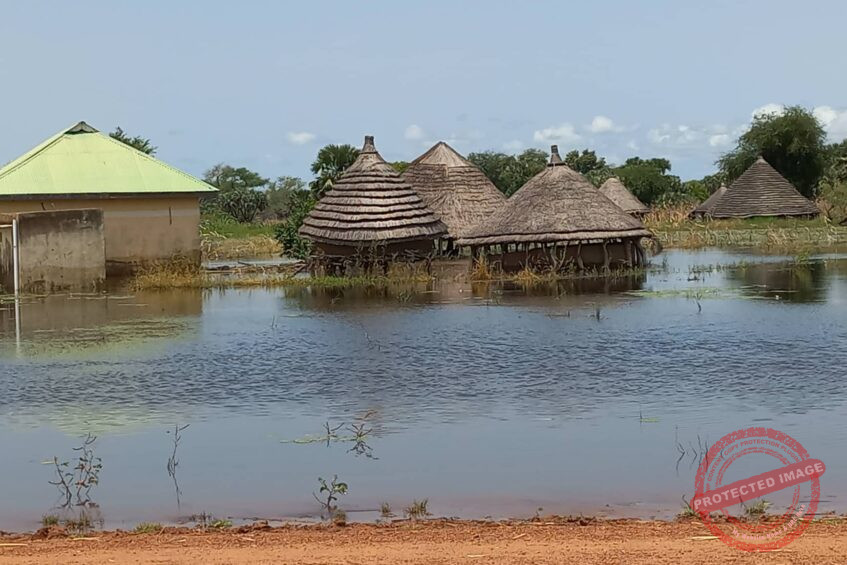
Abandoned villages submerged by floods in Northern Bahr el Ghazal. (Photo: Michael Daniel.)
The Minister of Environment and Forestry Josephine Napwon, has expressed frustration over the slow progress in securing climate finance to support national climate change projects.
Speaking on state-owned South Sudan Broadcasting Corporation (SSBC) on Sunday, Minister Napwon said funding is critical to implementing climate treaties and policies. She stressed the need to operationalize the loss and damage funds, which she said have remained stalled despite years of discussions.
“One of our priorities is climate finance, which we know is very critical in the implementation of our climate, our climate treaties and policies,” said Napwon.
“This has been a concern, and every year we talk about it in all the courts. But it seems there is nothing that is materializing, because without funding, we can do nothing special on our projects on climate change,” she added.
She also emphasized the need to operationalize the loss and damage fund.
“The second priority that we have is capitalization and operationalization of the laws and damage funds. And you understand that very well. It has also been a trophy every year. We have been talking about this. And we believe that in this COP30 that something will come out of this meeting that we are going to.”
COP30, the 30th Conference of the Parties to the UN Framework Convention on Climate Change (UNFCCC), will take place in Belém, Brazil, from 10 to 21 November 2025.
The Environment Minister also raised concerns about slow progress in implementing the COP29 Declaration on the 2030 Global Financial Framework.
COP29, held earlier this year, focused on setting a new global climate finance target to replace the current $100 billion-a-year goal, which expires in 2025. The new target is expected to guide funding until 2030.
Discussions at the summit centered on how much support developed countries should provide to help developing nations cut emissions, adapt to climate impacts, and address loss and damage.
Meanwhile, British Ambassador to South Sudan David Ashley highlighted the country’s vulnerability to climate change. He said South Sudan is the second most at-risk country in the world and called for urgent global action.
“Here in South Sudan, or Europe, increased temperatures and how that is translating into increased flooding, which we’re seeing across South Sudan, the extreme weather events which are taking place kind of on every continent, and the impact that has,” said Ashley.
“We know that in the case of South Sudan is, I think, the second most vulnerable country in the world. And in terms of climate change, that is only further complicating an already challenging development agenda. So, getting the world to reduce emissions is moving as soon as possible to renewable energy.”
The UNFCCC, signed in 1992, brings countries together to stabilize greenhouse gas levels and tackle global warming. The annual COP summits are used to review progress and agree on new actions.

Currently on air
08:00:00 - 08:10:00
 1
1Published August 23, 2026
 2
2Published August 23, 2026
 3
3Published August 19, 2026
 4
4Published August 19, 2026
 5
5Published 22 hours ago
 6
6Published August 20, 2026
 7
7Published August 21, 2026
 8
8Published 21 hours ago
Published 13 hours ago

Published 13 hours ago
Published 13 hours ago
Published 14 hours ago
Published 14 hours ago

Published 15 hours ago
Support Eye Radio, the first independent radio broadcaster of news, information & entertainment in South Sudan.
Make a monthly or a one off contribution.
Copyright 2026. All rights reserved. Eye Radio is a product of Eye Media Limited.