
20th February 2026
You are here: Home | Economy | Humanitarian | News | UoJ vice chancellor urges China to help flood-prone South Sudan grow rice
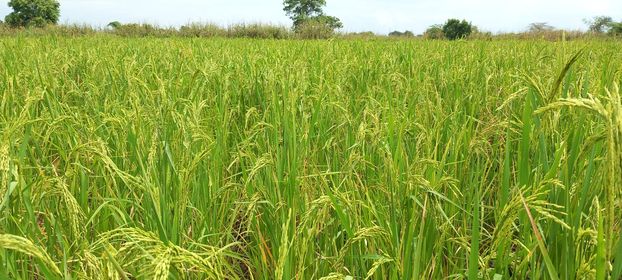
Rice plantation in Twic County. (-)
The University of Juba Vice Chancellor Prof. Robert Mayom appealed to China to help South Sudan plant rice in flood-prone areas as part of mitigating and adapting to the impact of flooding in the country.
According to an international group citing climate data, more than 3 million people will be impacted by a major flood event in South Sudan in the second half of 2024, many of whom will need humanitarian assistance.
IMPACT Initiatives said by September and October, when floodwaters have peaked, relief actors will grapple with a scenario in which more than three million people are affected and 2.4 million need aid.
The data provider further underscored that the “disastrous and longstanding humanitarian impacts” of the consecutive years of severe flooding between 2019 and 2022, signal what the projected situation could look like.
Prof. Mayom, the Vice Chancellor of the University of Juba, appealed to Beijing to help South Sudan introduce crops such as paddy rice that thrive in submerged conditions.
“We have floods in so many areas, and I understand that rice thrives very well in water. So we can really change our mental attitude of growing thing like Dura and then revert to rice and I am sure it can work,” said said during a donation event of China’s CNPC firm to the university.
“If this theory works very well in areas of water, then this is an area I would like you to actually help us. Let us grow rise, it will help the common man the countryside and also those who are in the urban areas.”
Meanwhile, the Chairperson of the Civil Society Coalition on Natural Resources also supported the proposal of planting rice in the flood-prone areas.
Charles Judo said there is also a need for South Sudan to dig artificial lakes to store a large volume of water for irrigation and as part of a long-term solution to flooding.
“I can concur with the proposal since it is actually part of mitigation and adaptation as well. We are trying to adapt ourselves to the situation, we are not trying to put away,” he said.
“One thing is the planting of rice in those areas and I can add the suggestion of digging lakes that can contain large waters for irrigation use as the most important part of it.”
In June 2023, Dr. John Garang Memorial University of Science and Technology in Jonglei State said it launched a Rice Plantation initiative in a new agricultural method adapting to flooding.
Jonglei state was submerged by seasonal floods for four years, and this prompted the university to plant climate-resilient crops as flooding in rice fields improves the growth of most varieties and reduces vulnerability to uneven rainfall.
At the same time in Warrap, the state government introduced rice plantation which started with the cultivation of 8.4 hectares of land, amid concerns that cattle of the pastoral communities may pose a challenge to the plantation.

Currently on air
00:00:00 - 06:00:00
 1
1Published February 16, 2026
 2
2Published February 14, 2026
 3
3Published February 13, 2026
 4
4Published February 15, 2026
 5
5Published February 16, 2026

Published 9 hours ago
Published 10 hours ago
Published 11 hours ago

Published 11 hours ago

Published 11 hours ago

Published 12 hours ago
Support Eye Radio, the first independent radio broadcaster of news, information & entertainment in South Sudan.
Make a monthly or a one off contribution.
Copyright 2026. All rights reserved. Eye Radio is a product of Eye Media Limited.