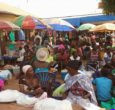
Yusuf Batil refugee camp, South Sudan (Photo: IRRI)
Refugees fleeing conflict in Sudan are facing hunger and disease in South Sudan as humanitarian funding dries up, food rations are squeezed, and the cost of food soars, Save the Children said.
They join over 290,000 Sudanese refugees who fled to South Sudan following violence in previous years.
The UN’s World Food Programme (WFP) provides food rations and cash to refugees and South Sudanese returnees fleeing conflict in Sudan.
Recent funding shortfalls however have meant that since 2022, refugees seeking safety in South Sudan only receive half of what the WFP considers a full food ration.
Now, further cuts are taking place in the refugee camps which will affect the majority of Sudanese refugees that fled to South Sudan before April 2023 and will leave many more established refugee families without any direct food assistance.
While the most recent arrivals from Sudan won’t be impacted, nor the most vulnerable refugees from previous influxes, many of the refugees living in the camps will soon see their food assistance end and be replaced by support to build livelihoods.
The scaleback is the result of ongoing funding constraints as well as pressures caused by the increasing number of new arrivals in the camps, a major concern since the start of the conflict in Sudan.
One camp leader in Maban County told Save the Children that he feared that the food cuts affecting the longer-established refugee community in South Sudan would prompt people to leave the camp.
Some refugees told Save the Children they would even consider going back to Sudan despite a lack of safety.
Assistance to refugee and returnee communities in South Sudan is currently provided through a mix of cash, pulses, vegetable oil and sorghum, a local staple crop.
The country’s economic crisis, however, threatens to deteriorate the value of the already inadequate food ration even further for those who will continue to receive it.
While WFP adjusts the value of cash transfers based on regular market price assessments, a rapidly declining South Sudanese Pound means that transfers continue to lose value even once in the hands of the people who need them.
Marium, 40, fled Sudan in January 2024 and lives in a refugee camp in Maban with her five children.
Her son, Harun, 8, has a back problem which has left him incontinent and in need of an operation.
The family were separated from Marium’s husband in the violence and chaos that ensued as they fled Khartoum.
Marium receives just $0.70 per person per day for her family for 14 days per month – half of the full WFP ration.
“We are getting food support every month but there isn’t enough as I’m the only one taking care of the children and they have so many expenses. Harun requires a lot of support – I need to use some of the money we have for food to buy clothes for him, as he always wets himself.”
Across the border in Sudan, the fighting which broke out in April last year has fuelled one of the world’s most severe humanitarian crises and shows no signs of abating, so far displacing 10.4 million people.
Last month,
Save the Children said its clinics in the states of Darfur and Kordofan were seeing rates of severe acute malnutrition (SAM) skyrocket as fighting has halted food production in key areas.
Conditions for refugees in South Sudan are dire, as new arrivals live in flimsy shelters that offer little protection from the elements, while sanitation is poor.
Diseases that are particularly deadly to children are rife with recent outbreaks of measles, conjunctivitis, pneumonia and diarrhea.
The looming threat of malnutrition from food shortages brings more risk of these diseases, with severe acute malnutrition (SAM) shutting down children’s immune systems and making otherwise non-life-threatening conditions like diarrhea potentially lethal.
Famari Barro, Save the Children Interim South Sudan Country Director, said:
“South Sudan is in the depths of a humanitarian disaster: already one of the world’s poorest countries, reeling from impacts of the climate crisis and food insecurity, and now hosting hundreds of thousands of people fleeing conflict in neighbouring Sudan.
“Hundreds of thousands of children across the country rely on food rations to survive – many will now be plunged into even further precarity and exposure to malnutrition, disease and protection risks like child marriage or labour as families are forced to desperate measures.
“The conflict in Sudan has triggered a regional crisis and the world must not turn its back on children and families who are paying the price. We need a huge uptick in funding from the international community to save lives.”
Save the Children is calling for a massive injection of funding from the international community for the UN’s 2024
humanitarian response plan for South Sudan – currently just 43% funded – in order to allow the World Food Programme to continue delivering food assistance.
The aid group is also calling for the international community to fully fund the UN’s
humanitarian response plan for Sudan, and for an immediate ceasefire and meaningful progress towards a lasting peace agreement.


 1
1 2
2 3
3 4
4 5
5 6
6 7
7 8
8