More than 300 beneficiaries of the government-led Shabaka Maisha social safety net program say they are considering a peaceful protest over six months of unpaid payments.
Speaking to Eye Radio, Samuel Bakhit, a beneficiary of the World Bank-funded project, said he and other group members have not received their outstanding payments for undisclosed reasons.
Bakhit said the beneficiaries received payments for nine months but are still waiting for the remaining six months.
“We are only paid for nine months and we are left with six months which are not paid. We want them to clear the arrears that are left with them. If they fail to respond to us, we will go back to their offices and see what is going to happen,” Bakhit said.
He warned that the group could organize a peaceful march to the United Nations Office for Project Services (UNOPS) if their concerns are not addressed.
Responding to the concerns, Ohisa James, Deputy Project Manager for Shabaka Maisha at the Ministry of Agriculture and Food Security, said discussions with relevant stakeholders are at an advanced stage to resolve the outstanding payments.
James attributed the delay to changes in the project’s implementation arrangement after the new Minister of Agriculture decided to revoke the existing agreement with UNOPS and called for its renegotiation.
“There is some change in the implementation arrangement. The new Minister of Agriculture came with a new idea to revoke the agreement with UNOPS and requested that it be renegotiated. This has been ongoing between the ministry, UNOPS and the World Bank,” James said.
He assured beneficiaries that the six months’ payments would be made once the agreement is finalized.
“It’s not that we are not going to be paid. The payment will come for six months and it is going to be done at once,” he added.
Eye Radio contacted UNOPS for comment but the agency was unavailable at the time of broadcast.
Shabaka Maisha, officially known as the South Sudan Productive Safety Net for Socioeconomic Opportunities Project (SNSOP), is a five-year, $199 million program funded by the World Bank and launched in 2023.
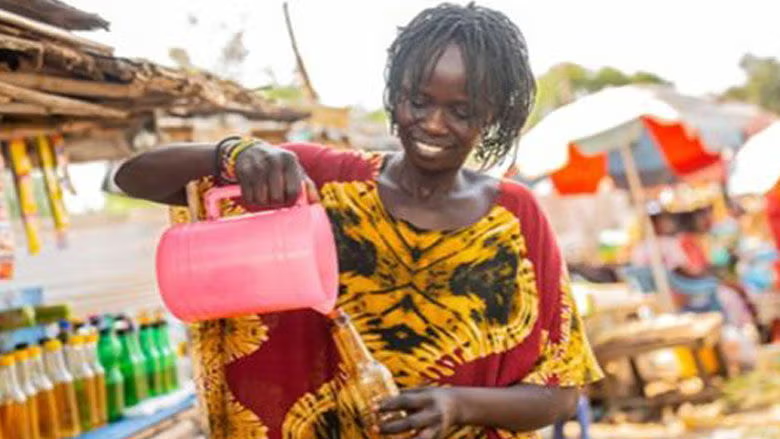
The initiative provides cash transfers, labor-intensive public works and livelihood opportunities to vulnerable communities. It targets 157,000 households across 20 counties, including refugees and host communities.
So far, more than 87,000 households in 15 counties have received temporary income support through the program.