
10th July 2026
You are here: Home | Governance | News | Bishop Tombe calls for hefty retirement packages for liberation leaders
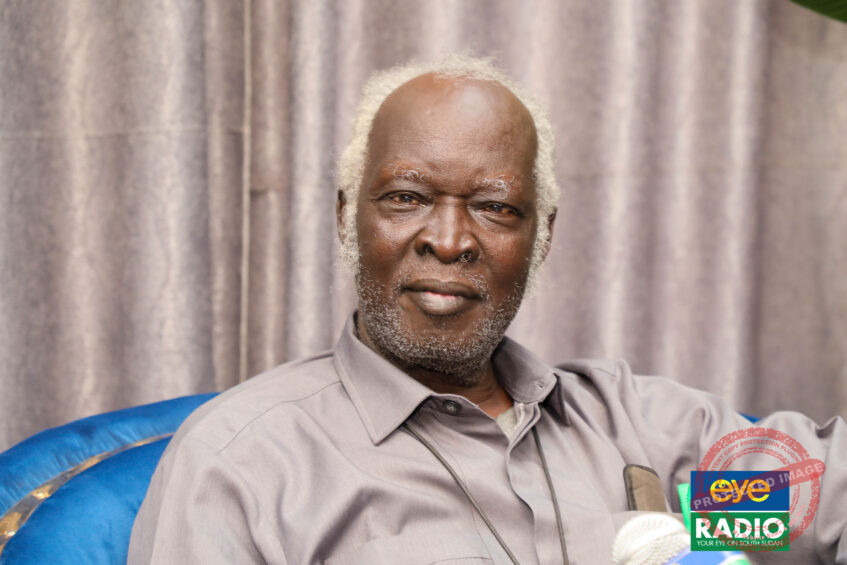
Retired Bishop Enock Tombe | Photo Credit: Eye Radio/Darlington Moses
Retired Anglican Bishop Enock Tombe has called for the compulsory retirement of liberation-era leaders, accompanied by generous retirement packages, to make way for professionals who can drive the country’s development and state-building efforts.
Speaking during Eye Radio’s podcast on Friday, Bishop Tombe acknowledged the contribution of liberation leaders in securing the country’s independence.
However, he said the current stage of nation-building requires a different kind of leadership.
“When it comes to leadership, this is the leadership that came out of the liberation struggle. They know how to fight, and they succeeded. But now, we need a different kind of leadership to build the nation and the state,” he said.
“You cannot use a gun for that. Peter Nyaba has mentioned this: we need a different tool. You can’t use a gun to build; a gun is for destruction. To build now, we must bring in professionals; medical doctors, engineers, architects, IT experts,” he added.
Bishop Tombe also said “Some people still cannot even use IT. So, we should use younger people. For me, I’ve been saying that anyone over 65 should retire. What we need is compulsory retirement for these elders. Anyone above 65 must step down and receive retirement packages. I’m telling you, they will be very happy. If the government wants to follow this example, we are ready to advise.”
He recommended that anyone above the age of 65 should step down and be offered generous retirement packages as a way of appreciating their service to the nation.
He further proposed that retired leaders who are still fit should be appointed as national or regional envoys so they can remain active and feel valued.
“One of the things we should do to thank these people who struggled for 21 years is to show appreciation,” he said.
“Patrick Lumumba of Kenya once said, instead of blaming them, we should prepare generous retirement packages. Then respectfully say, ‘General, Your Excellency, you are tired. Here is our gift. Now please, rest.”
Bishop Tombe said the growing public demand for a shift in leadership is a sign that South Sudan’s future depends on the involvement of trained professionals in shaping the country’s path forward.
The bishop recalled that the idea of formally retiring liberators with appreciation packages was first proposed by Kenyan legal scholar P.L.O. Lumumba at a meeting in Bahir Dar, Ethiopia in September 2014.
Tombe, who attended as a representative of the South Sudan Council of Churches (SSCC), lamented that the proposal was never implemented.
“Since P.L.O. Lumumba of Kenya gave us that proposal of giving retirement packages to former liberators — in appreciation for their sacrifices during the liberation struggles of 1955–1972 and 1983–2005 — no action has been taken. I was present at the Bahir Dar meeting representing SSCC.
Now, due to multiple factors, including the high cost of government operations (salaries, office running costs, meetings, etc.) and the ongoing civil war in Sudan since April 2023, which has disrupted oil flow to Port Sudan for export, the country can no longer sustain the spending levels we saw from 2005 to 2012.
“There’s no more cash in the banks, as we’ve heard in the media,” he said.
“Therefore, my view is that we implement Lumumba’s advice: retire those who have reached 65 years of age, as stipulated in the Public Service Regulations.”
Bishop Tombe outlined five key benefits of such a policy:
Retired civil servants over 65 would receive their post-service benefits and be able to rest from years of hard service.
New, younger professionals could be recruited through formal public service procedures, bringing fresh ideas and modern skills into institutions.
Retired officials still mentally and physically capable could serve as mentors for younger leaders, sharing valuable experience from the liberation years — especially from the Anya-Nya days, when corruption was not tolerated as it is now.
Youth-driven insecurity could be reduced by creating more employment opportunities for young people.
Peace and stability would improve, creating a better environment for local and international investment.
He also suggested appointing fit retirees as envoys or advisers to keep them active and appreciated, citing examples such as former South African President Thabo Mbeki.

Currently on air
00:00:00 - 06:00:00
 1
1Published July 5, 2026
 2
2Published July 6, 2026
 3
3Published July 6, 2026
 4
4 5
5Published July 7, 2026
 6
6Published July 8, 2026
 7
7Published July 8, 2026
 8
8Published July 7, 2026

Published 5 hours ago

Published 7 hours ago

Published 7 hours ago

Published 10 hours ago
Published 12 hours ago
Published 12 hours ago
Support Eye Radio, the first independent radio broadcaster of news, information & entertainment in South Sudan.
Make a monthly or a one off contribution.
Copyright 2026. All rights reserved. Eye Radio is a product of Eye Media Limited.