
18th August 2026
You are here: Home | Governance | Health | Adut visits health facilities amid Ebola preparedness efforts
Photo|Courtesy
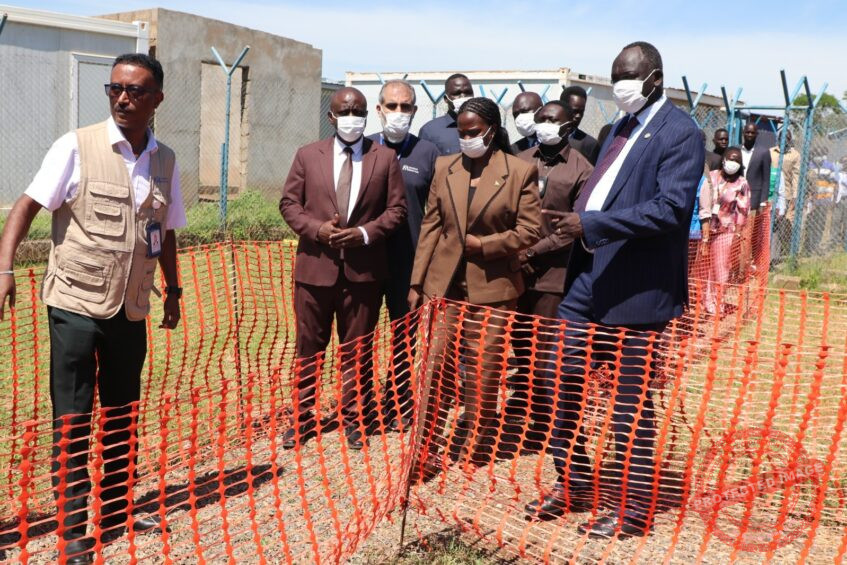
Senior Presidential Envoy on Special Programs, Adut Salva Kiir, on Tuesday paid a courtesy visit to the National Public Health Institute (NPHI) and the Infectious Disease Unit (IDU) in Juba as the government intensified efforts to prepare for any possible spread of the Bundibugyo Ebola Virus Disease outbreak affecting parts of the region.
Accompanied by the Minister of Health, Luke Thomson Thoan, and the World Health Organization (WHO) Representative to South Sudan, Dr. Humphrey Karamagi, Adut received briefings on the country’s preparedness measures and response capacity.
The delegation was welcomed by officials from the National Public Health Institute and representatives of UNICEF South Sudan, Africa CDC, International Medical Corps (IMC), and other health partners.
Speaking during the visit, Adut said the government remained committed to protecting citizens from public health emergencies and called for greater public awareness on Ebola prevention.
“The health of our people is a top priority. I am grateful for the continued efforts to protect communities across the country,” she said.
She urged health authorities and partners to strengthen community sensitization, particularly at the grassroots level, saying access to accurate information would be crucial in preventing the spread of the disease.
“Given the threat of Ebola, it is important that we educate our people, especially at the grassroots level, to ensure they have the necessary information to protect themselves,” Adut said.
In a move aimed at strengthening emergency response operations, Adut announced that the government would provide up to ten vehicles to support the activities and mobility of the National Public Health Institute during the preparedness period.
At the Infectious Disease Unit, which serves as an isolation and potential treatment centre for Ebola cases, Adut met healthcare workers and commended them for their service.
The facility was established by the World Health Organization during the COVID-19 pandemic on a site earmarked for a future government forensic laboratory. It has since been adapted to respond to various infectious disease threats and now forms part of South Sudan’s Ebola preparedness infrastructure.
The Bundibugyo Ebola isolation and treatment centre is managed by the International Medical Corps with operational support from the European Union Civil Protection and Humanitarian Aid Department, while the World Health Organization provides medical equipment and supplies.
Health authorities said surveillance activities, community awareness campaigns and response mechanisms are being strengthened across the country to reduce the risk of Ebola transmission and ensure rapid detection and containment of any suspected cases.
The visit comes as health officials continue to monitor developments in the region and coordinate preparedness efforts with national and international partners.
Currently on air
06:00:00 - 06:55:00
 1
1Published August 16, 2026
 2
2Published August 16, 2026
 3
3Published August 11, 2026
 4
4Published August 12, 2026
 5
5Published August 11, 2026
 6
6Published 12 hours ago
 7
7Published August 13, 2026
 8
8Published August 12, 2026

Published 11 hours ago
Published 12 hours ago

Published 12 hours ago

Published 13 hours ago

Published 16 hours ago
Support Eye Radio, the first independent radio broadcaster of news, information & entertainment in South Sudan.
Make a monthly or a one off contribution.
Copyright 2026. All rights reserved. Eye Radio is a product of Eye Media Limited.