
23rd May 2026

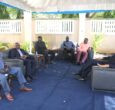
Hon. James Monyluak Mijok (Left), Hon. Nyakeny Keah during Media-Security Conference in Juba, May 19-21 Courtesy
An exchange of words over border security and land use between regional information ministers marked the conclusion of the Media and Security Sector conference in Juba on Thursday, prompting intervention from military authorities.
The debate involved Ruweng Administrative Area Information Minister Hon. James Monyluak Mijok and Unity State Information Minister Nyakenya Keah regarding cattle raiding and agricultural activities in border zones.
Minister Monyluak opened the exchange by questioning the measures that Unity State authorities implement to deter armed youth from conducting cross-border raids.
“What is Unity State doing in regard to youth carrying out cattle raiding and killing of citizens from the Ruweng Administrative Area?” Monyluak asked.
Minister Monyluak also requested clarification regarding the presence of Vice President Taban Deng Gai in the Manga area, questioning the geographic jurisdiction of his agricultural projects.
“What is your response to the fact that Vice President Taban is conducting farming activities in Manga, Payam or Toy County, Ruweng Administrative Area?” Muongluak inquired, while making an appeal for coexistence between the neighboring communities.
In her response, Unity State Information Minister Nyakenya Keah stated that the concerns carried weight, noting that officials from both administrations maintain daily communication channels to manage border security. Keah emphasized the historical and cultural ties between the two areas.
“Unity State and Ruweng Administrative Area are one and the same because that is the greater unity,” Keah said.
Addressing the security environment, Keah clarified that Unity State does not maintain or recognize youth militias, attributing cross-border incidents to independent armed actors operating across regional boundaries.
“We don’t have a recognized youth militia,” Keah stated. “We have these criminals that move around, of which even Ruweng Administrative Area has them. We have people who do have guns in the whole country, and that is why there was a disarmament taking place in Unity State and some other parts of the country.”
Keah reported that Unity State Governor Dr. Joseph Monytuil recently led a peace mission to Mayom County to hold consultations with youth and chiefs regarding the root causes of raiding. According to state records, these stabilization efforts reduced security incidents over the past month.
“Over the past one month, when the Governor of Unity State went to Mayom, these cases of raiding of cattle have reduced greatly,” Keah noted, adding that cattle owners in Unity State also experience raids originating from the Ruweng side. “This is an issue that is collective, and both our governments should be working hand-in-hand.”
Regarding the projects of Vice President Taban Deng Gai, Keah stated that the activities represent personal economic initiatives.
“Taban Deng Gai is a son of Unity State and also a Vice President of the Republic of South Sudan,” Keah said. “As a Vice President, he has his roots. He can decide to go and visit his people. He can decide to go and do his personal economic activities… to see his family and also to see his farms.”
Keah concluded by stating that current administrative practices recognize Manga as part of Unity State. “This issue of boundaries, we are not going to discuss it here,” Keah said.
Reacting to the exchange between the two ministers, the spokesperson for the South Sudan People’s Defence Forces (SSPDF), Major General Lul Ruai Koang, called on state information ministers and spokespersons to practice restraint when discussing territory. He stated that public claims to disputed areas trigger intercommunal violence.
Major General Koang noted that territory and border disputes exist across the ten states and three administrative areas, citing the conflict between Abyei and Warrap State’s Twic County to show how territorial disagreements impact communities. He urged state ministers to use communication channels to share information that promotes connection and coexistence rather than tension.
Lul explained that the national government has deferred the resolution of internal border disputes, noting that the state currently lacks the enforcement mechanisms required to implement boundary decisions without consensus.
“The message to our state ministers is that land disputes exist in the ten states and administrative areas,” General Lul stated. “Disputes in the past resulted in loss of life. The government attempted to resolve these issues. An example is the clashes between Warrap and Abyei. A delegation traveled under the Vice President for the Service Cluster. Recommendations were made, but implementation faced obstacles.”
The spokesperson called on officials to acknowledge institutional limits and focus instead on community harmony.
“The policy of the government is the deferment of land disputes,” General Lul said. “We are deferring them now because we are not in a position to finalize the settlement of these issues. If a settlement is done and contested, we lack the enforcement agencies to implement the verdict.”
He concluded with an appeal to the ministers to frame public narratives around partnership rather than division.
“When you issue responses, let them be responses that reconcile the government and the communities,” General Lul said. “Neighbourliness is what is needed.”

Currently on air
00:00:00 - 06:00:00
 1
1Published May 17, 2026
 2
2Published May 22, 2026
 3
3Published May 18, 2026
 4
4Published May 19, 2026
 5
5Published May 20, 2026
 6
6Published 8 hours ago
 7
7Published May 18, 2026
 8
8Published May 18, 2026
Published 7 hours ago
Published 8 hours ago

Published 11 hours ago

Published 12 hours ago
Published 12 hours ago
Published 14 hours ago
Support Eye Radio, the first independent radio broadcaster of news, information & entertainment in South Sudan.
Make a monthly or a one off contribution.
Copyright 2026. All rights reserved. Eye Radio is a product of Eye Media Limited.