
2nd September 2026
You are here: Home | Editorial | National News | News | South Sudan’s constitutional shortcut to elections: What could changing the peace deal mean for the country’s politics?
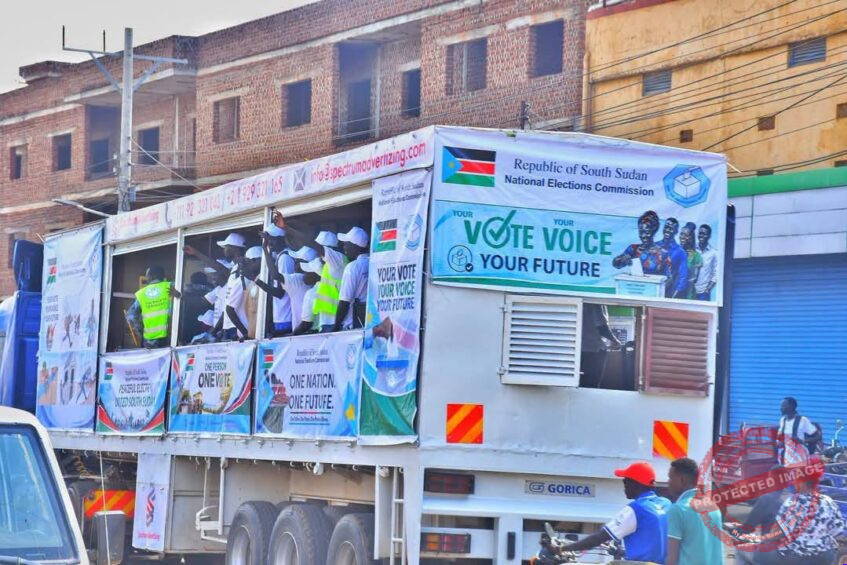
A National Elections Commission roadshow vehicle drives through the streets of Juba ahead of the launch of the civic and voter education campaign. Courtesy photo.
JUBA — South Sudan is once again changing the legal framework governing its political transition, with the National Legislature approving amendments that the government says are necessary to remove obstacles to the December 2026 elections.
The move follows amendments to the 2018 Revitalized Peace Agreement that separated the electoral timetable from two major transitional requirements—the completion of a permanent constitution and the conduct of a national census.
That raises a fundamental question about the direction of the country’s transition:
Why has it become easier for South Sudan’s political leadership to change the rules governing the transition than to implement the provisions designed to make that transition credible in the first place?
The question is not whether South Sudan should eventually hold elections. After years of transitional government and repeated delays, there is a legitimate argument that the country cannot remain indefinitely suspended between war and peace, or between transitional government and elected government.
The more difficult question is whether changing the legal requirements for elections is sufficient to create the political, institutional and security conditions in which an election can actually produce a credible and sustainable democratic transition.
That distinction lies at the centre of South Sudan’s political dilemma.
Changing a rule is not the same as implementing the conditions behind it. A constitutional amendment can be negotiated, passed and enacted through a formal legislative process. Implementing a peace agreement, by contrast, requires resources, institutions, political compromise, security-sector reform, public participation and sustained cooperation among political actors who have spent years competing for power and, at different points, fighting one another.
The government’s argument is that the outstanding census and permanent constitution should no longer prevent elections from taking place.
On July 1, 2026, Oliver Mori Benjamin, caretaker chairperson of Parliament’s Information Committee, explained the amendment this way:
“The two main provisions amended concern the population census and the permanent constitution-making process. These have been deferred until after the elections and will be undertaken by the elected government.”
He added that the change would allow the National Elections Commission and political parties to accelerate preparations for the vote.
There is a logic to that position. South Sudan has already postponed elections repeatedly, and another delay could further weaken public confidence in the transition.
But it also creates a significant risk. If reforms originally intended to precede elections are moved to the period after elections, the government must convince the public and political opposition that this is genuinely a change in sequencing, rather than a decision to abandon or indefinitely postpone those reforms.
The Revitalised Agreement on the Resolution of the Conflict in South Sudan was not simply an agreement to hold elections.
It was designed to take the country from conflict and transitional government towards a more stable political order, with security arrangements, institutional reforms, constitution-making and electoral reforms intended to create the foundations for a peaceful political transition.
Yet many of those commitments remain incomplete. The concern is not new.
On February 27, 2026, the UN Commission on Human Rights in South Sudan said the country’s political and military leaders were “systematically dismantling” the 2018 peace agreement and undermining governance and security safeguards. UN Human Rights Commissioner Barney Afako was even more direct, warning:
“When leaders treat negotiated peace commitments as expendable, they create conditions in which violence flourishes.”
He said South Sudan was “at a dangerous crossroads.” The remarks were made as the Commission presented its findings to the UN Human Rights Council on February 27, 2026.
They are not being introduced in a political vacuum. They come after years of delayed implementation, repeated extensions and growing pressure to finally hold elections.
The transitional security arrangements provide one of the clearest examples of the difference between legal reform and practical implementation.
The peace process was intended to bring forces previously aligned to opposing political camps into a more unified national security structure.
That requires training, funding, deployment, command arrangements and—above all—political confidence between former adversaries.
Parliament can amend a constitutional provision in a sitting. It cannot create a unified national security force in a sitting.
This is why the condition of the security sector may ultimately matter more than the wording of the constitutional amendments.
If security institutions remain divided, underfunded or perceived as politically aligned, an election can take place in a technically legal environment while citizens and political parties remain uncertain about whether they can participate safely and whether security forces will protect the electoral process impartially.
South Sudan’s electoral institutions also require money, personnel, logistics and time. Setting December 22, 2026 as election day does not automatically mean the country is ready to conduct a credible election.
South Sudanese civil society groups and other stakeholders have repeatedly warned about this gap.
In a statement issued in Juba on July 7, 2026, stakeholders and adherents to the Revitalised Peace Agreement said: “A date, however welcome, does not in itself guarantee credible elections.”
They called for progress on security arrangements, the permanent constitution, the national census, civic and political space and the strengthening of electoral institutions.
Their strongest warning was even more pointed: Elections must be the outcome of a stable and enabling environment, not a substitute for one.” They also described the transition as “the defining test of political will.”
That argument goes to the heart of the debate. A legal amendment may remove an obstacle, but it cannot finance voter registration, train election officials, provide polling materials or create public confidence in the institutions responsible for counting and announcing the results.
The decision to postpone the permanent constitution is perhaps the most consequential part of the new approach.
A permanent constitution is not simply another administrative requirement. It is supposed to establish the political and legal framework under which South Sudan will operate beyond the transitional period—including questions of governance, distribution of power, citizens’ rights and the relationship between national institutions.
The constitution-making process was therefore intended to provide an opportunity for a broader national conversation about the kind of state South Sudan wants to become after years of conflict.
The issue is not whether the permanent constitution can technically be completed after elections.
It can. The real question is whether there will be sufficient political pressure and institutional commitment to complete it once the urgency surrounding the elections has passed.
If the new government emerges from the December polls and inherits the same unresolved constitutional questions, unfinished security arrangements and political disagreements that have characterised the transition, South Sudan may discover that it has ended one transitional phase without resolving the problems that created the need for transition in the first place.
Another concern lies in the process through which the rules themselves are being changed. The 2018 peace agreement is not simply an ordinary statute passed by Parliament. It is a political settlement between parties that were once in conflict.
If some of those parties believe that the rules of that settlement can be changed without adequate consultation or consensus, the amendment process itself can deepen the mistrust that the peace agreement was intended to overcome.
This creates a larger constitutional question: Can the institutions created by the peace agreement redefine the conditions under which that same transition is supposed to end?
The answer will affect not only the December elections but also the credibility of the peace process itself.
The government’s position should not be dismissed. Another extension could carry serious political costs. South Sudan has already spent years in transition, and indefinite postponement could weaken institutions, frustrate citizens and reinforce the perception that transitional government is becoming permanent.
The government therefore argues that outstanding reforms can continue after the elections and that the country needs to move towards an elected government rather than allowing the incomplete implementation of every transitional task to become an indefinite excuse for delaying the vote.
That argument would be considerably stronger if the government could demonstrate that the postponed reforms have firm timelines, guaranteed financing and broad political ownership.
The real issue is not whether every reform must be completed before election day. It is whether those reforms will remain politically binding after election day.
The greatest danger may not be the holding of elections itself, but the possibility that the election becomes contested because political actors do not trust the rules under which it was conducted.
In a country emerging from years of armed conflict, a disputed election can quickly become more than a constitutional or political disagreement.
If opposition parties believe that the legal framework was altered to favour the governing side, if citizens do not trust electoral institutions, if security forces are perceived as partisan, or if defeated candidates have no confidence in mechanisms for resolving disputes, the election could deepen political divisions instead of resolving them.
South Sudan therefore faces a particularly important test: Can its political system produce an electoral outcome that competing parties are prepared to accept even when they lose?
That requires more than legislation. It requires trust in institutions, confidence in the rules and credible guarantees that political competition will not return the country to confrontation.
South Sudan can amend its Constitution and create a legal pathway to the December elections. But that does not automatically mean the country has created the institutional capacity, political freedoms, security guarantees and public confidence required for a credible democratic contest.
The law can authorise an election. It cannot by itself guarantee that citizens are free to participate, that political parties can compete on a level playing field, or that the eventual loser will accept the result. Those things require political compromise—the very work that has proved hardest during the transition.
The government wants to end the transitional period through elections, but some of the legal and institutional requirements attached to that transition are being changed or postponed precisely to make the elections possible.
The country may therefore become legally ready for elections faster than it becomes institutionally ready for democracy.
That does not mean the December elections should automatically be rejected or postponed. It means their credibility will depend on what happens around the election as much as what happens inside the polling station.
Political parties need meaningful space to organise and campaign. Citizens need to participate without intimidation. Electoral institutions need adequate resources. Security forces need to remain professional and politically neutral. And there must be credible mechanisms for resolving disputes.
At the same time, the government needs to provide a clear and publicly accountable roadmap for completing the permanent constitution, security reforms and other outstanding provisions of the peace agreement after the election.
South Sudan needs credible answers on whether political parties will have meaningful space to organise and campaign, whether electoral institutions will receive the resources they need, and whether security forces will remain professional and politically neutral throughout the electoral process.
There must also be clear mechanisms for resolving electoral disputes and protecting journalists, candidates and voters from intimidation. At the same time, the government needs to provide a concrete and publicly accountable timetable for completing the permanent constitution and other outstanding provisions of the peace agreement.
These questions matter more than the election date alone.
If the government is confident that the postponed reforms will continue after the elections, it should have little difficulty putting those commitments into a clear, publicly accessible timetable that can be monitored by Parliament, political parties, civil society and international partners.
That would help demonstrate that the amendments are intended to change the sequence of the transition rather than weaken its substantive commitments.
The deeper question is therefore not simply whether South Sudan will vote in December 2026. It is what political order that vote is intended to create.
If the election produces a government that still faces an unfinished peace agreement, unresolved security arrangements, constitutional uncertainty and deep political mistrust, South Sudan will have succeeded in changing its legal framework without necessarily changing its political reality.
The country cannot remain in perpetual transition. But ending the transition should not mean simply removing the conditions attached to it.
The real challenge is to ensure that the election becomes a bridge from the peace agreement to a functioning democratic system rather than another political milestone followed by another cycle of unfinished reforms.
The easiest part may be changing the rules. The difficult part is creating the political conditions that make those rules meaningful.
South Sudan now has to demonstrate that its constitutional shortcut is genuinely a route out of transition—not simply another way of postponing the difficult work of implementing the peace agreement.
And that is why the most important question surrounding the December elections is no longer simply:
“Will South Sudan vote?” It is: “Will the election finally move South Sudan from transitional politics to a legitimate and accountable political order?”
This article brings together diverse views, official statements, analysis and commentary from South Sudanese authorities, civil society, international organisations, journalists and political analysts. The inclusion of a particular view or quotation does not imply endorsement by this page. Direct quotations are attributed to their original speakers or sources and are presented in their original context. The analysis and questions raised in this article are intended to encourage informed public discussion and debate.
 1
1Published August 29, 2026
 2
2Published September 1, 2026
 3
3Published August 30, 2026
 4
4Published August 28, 2026
 5
5Published August 31, 2026
 6
6Published August 31, 2026
 7
7Published September 1, 2026
 8
8Published August 31, 2026

Published 4 hours ago
Published 5 hours ago


Published 7 hours ago
Support Eye Radio, the first independent radio broadcaster of news, information & entertainment in South Sudan.
Make a monthly or a one off contribution.
Copyright 2026. All rights reserved. Eye Radio is a product of Eye Media Limited.