
18th August 2026
You are here: Home | Business & Economy | Economy | Governance | National News | News | Rising prices squeeze families as traders lose customers at Gudele market
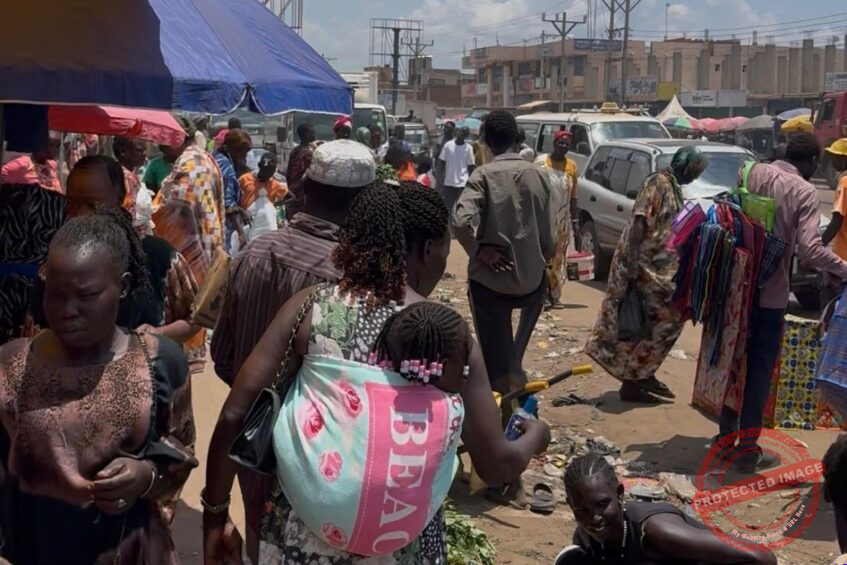
Photo Credit|Courtsy
Families in Juba are struggling to afford basic food and household goods as rising prices squeeze household budgets, while traders at Kubri Haboba Market say they are losing customers as more people cut back on what they buy.
The traders and consumers are calling for government action to address the exchange rate, taxation and high transport costs, which they say are driving up the price of essential commodities.
Market vendors say commodity prices often remain high even when the value of the US dollar falls. They are calling for stronger monitoring to determine why prices do not fall alongside changes in the exchange rate.
Martin Wani Tartiso, a boda boda cyclist operating at the market, says the absence of effective price regulation allows sellers to set different prices for the same goods.
“Everyone sets their own prices of goods,” Tartiso said.
He called on the government and security authorities to monitor prices and establish whether high costs are being driven by wholesalers, retailers or fluctuations in the exchange rate.
Tartiso also pointed to costs along the Juba-Nimule trade route, saying taxes and other charges imposed on trucks transporting goods can eventually be passed on to consumers.
The Juba-Nimule corridor is a major trade route for South Sudan. About 90 percent of the country’s imports arrive by truck through Nimule, according to a recent study, while numerous checkpoints along the route can add to the cost of transporting goods.
For consumers, the impact is being felt directly at household level. Sarah Keji, who sells milk at the market, says falling purchasing power has reduced demand for her products.
“Milk no longer brings in any money. People who come and buy milk no longer have money,” she said.
Keji appealed to the government to reduce the cost of essential goods, saying the economic pressure is particularly difficult for women and families struggling to put food on the table.
Consumers say the problem extends beyond individual commodities.
Suzanne David, a market-goer, says even households that try to produce some of their own food still have to buy essentials such as salt, which she says remain expensive.
“If the government intervenes and sees about the border, then things will be like before and things will be cheaper,” she said.
Mama Maria said prices vary significantly from one seller to another. She cited prices of about 8,000 South Sudanese pounds for a kilogram of sugar and similar prices for maize and other flour products, calling for stronger monitoring to prevent arbitrary pricing.
She also urged the government to improve roads connecting Juba with food-producing areas such as Yei, Maridi and Yambio. Better roads, she said, could make it easier and cheaper to bring locally produced food to the capital.
Butchers are also feeling the impact of higher transport and border-related costs.
Nyombe Warangyang says bringing cattle from Uganda has become more expensive because of difficulties and charges along the border. He says the price of meat has consequently risen to about 40,000 South Sudanese pounds per kilogram, putting it beyond the reach of many ordinary consumers.
The challenges at Kubri Haboba Market reflect wider economic difficulties facing South Sudan.
The World Bank says food inflation reached about 234 percent in FY2025, while the South Sudanese pound experienced a sharp depreciation against the US dollar. The Bank has also linked the economic crisis to falling oil production, government financing pressures and salary arrears.
Food insecurity is adding to the pressure. The World Food Programme and UNHCR have warned that more than 7.8 million people in South Sudan are facing acute food insecurity, alongside millions affected by economic hardship and displacement.
At Kubri Haboba Market, traders say the consequences are visible in declining customer numbers, while consumers say their incomes can no longer keep pace with the rising cost of living.
Their message to the government is clear: reduce the costs of transport and imports, strengthen monitoring of commodity prices, address pressures along trade routes and improve roads so that food can reach Juba at prices ordinary families can afford.

Currently on air
14:00:00 - 15:55:00
 1
1Published August 16, 2026
 2
2Published August 16, 2026
 3
3Published August 11, 2026
 4
4 5
5Published August 12, 2026
 6
6Published August 17, 2026
 7
7Published 21 hours ago
 8
8Published August 13, 2026

Published 36 minutes ago


Published 3 hours ago

Published 3 hours ago

Published 3 hours ago

Published 3 hours ago
Support Eye Radio, the first independent radio broadcaster of news, information & entertainment in South Sudan.
Make a monthly or a one off contribution.
Copyright 2026. All rights reserved. Eye Radio is a product of Eye Media Limited.