
26th August 2026
You are here: Home | Central Equatoria State | Humanitarian | News | Gov. Mujung, ICRC discuss urgent humanitarian response in Kajokeji
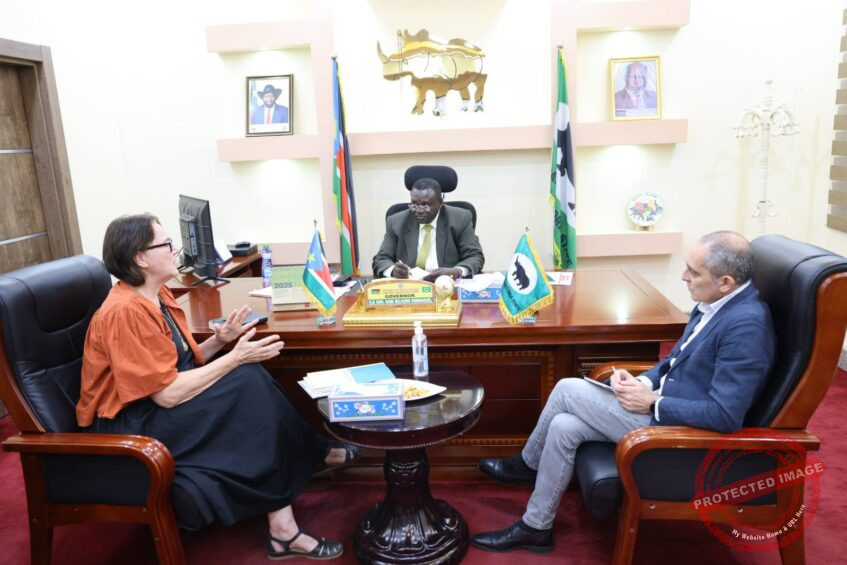
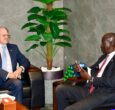
Central Equatoria State Governor, Rabi Mujung Emmanuel meeting ICRC delagation in his office at the State Secretariat - Photo credit: Office of the Governor, CES
The Governor of Central Equatoria State has discussed the worsening humanitarian situation in Kajo-Keji County with the International Committee of the Red Cross (ICRC), following recent border tensions with Uganda.
Governor Rabi Mujung Emmanuel held a closed-door meeting on Wednesday morning with Florence Gillette, the Head of Delegation for the ICRC in Juba.
The discussion focused on mobilizing support for thousands of civilians displaced by last week attacked on parts of Kajokeji by the Uganda People’s Defense Forces (UPDF), which led to the killing of personnel of South Sudan’s joint forces and massive displacement of civilians.
Governor Mujung stressed the urgent need to support the affected communities and praised the ICRC for its continued assistance to the people of Central Equatoria.
He also reiterated the State government’s commitment to working closely with humanitarian partners to address the unfolding crisis.
Florence Gillette, the ICRC head of delegation, described the meeting as productive and reaffirmed the organization’s commitment to conducting joint assessments with state authorities.
“Two major points, one is the situation of the people who have been displaced in Kajo-Keji county following tensions at the border between South Sudan and Uganda, and seeing what the needs are and how this can be addressed,” she said.
“This is also why we have our colleagues from the Relief and Rehabilitation Commission for Central Equatoria with us, and we discuss those challenges,” she added.
Ms Florence also said they a handover of a large scale water scheme built ICRC support more than 100,000 people in Rajaf Payam of Juba County.
Ms. Florence Gillette said the meeting also the hand over of an ICRCbuilt large-scale water scheme in Rajaf Payam, Juba County, which now provides clean drinking water to over 100,000 people.
The Chairperson of the State Relief and Rehabilitation Commission, Rose Lisok, described the situation in Kajo-Keji as dire and called for more humanitarian actors to join the response.
“Today specifically, we came for Kajo-Keji people. As she stated, we had a very difficult, alarming situation of our people who are affected by Ugandan army that they came to attack our people on our soil,” she said.
She said the displaced people have been devastated by the attack and need urgent humanitarian support.
“As a result [by the Ugandan army], we have a massive displacement of the people. As I’m talking now, the situation is still tense, and people are affected, devastated, and they need a lot of support,” she added.
According to the Commissioner of Kajo-Keji County, the violence has displaced 2,934 households, affecting a total of 16,304 people.
The immediate humanitarian needs include food, shelter, cooking utensils, medical supplies, and access to clean drinking water.
Currently on air
07:10:00 - 07:55:00
 1
1Published August 23, 2026
 2
2Published August 23, 2026
 3
3Published August 19, 2026
 4
4Published August 24, 2026
 5
5Published August 19, 2026
 6
6Published August 20, 2026
 7
7Published August 24, 2026
 8
8Published August 21, 2026
Published 11 hours ago
Published 11 hours ago
Published 12 hours ago
Published 13 hours ago

Published 14 hours ago

Published 15 hours ago
Support Eye Radio, the first independent radio broadcaster of news, information & entertainment in South Sudan.
Make a monthly or a one off contribution.
Copyright 2026. All rights reserved. Eye Radio is a product of Eye Media Limited.