
4th September 2026
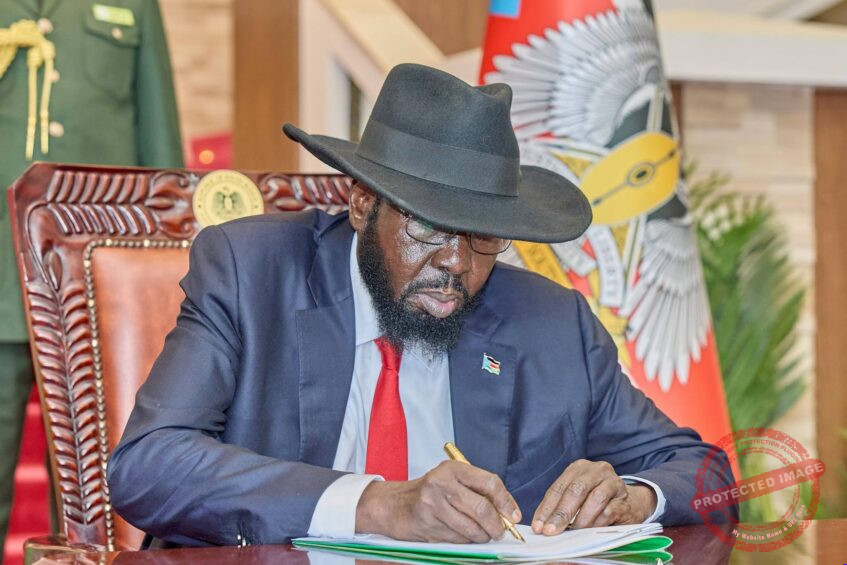
President Salva Kiir signs Constitutional Amendment No. 13 into law on Wednesday, September 2, 2026, removing key legal hurdles ahead of the planned December 2026 polls. (Photo: Office of the President)
South Sudan’s preparations for the December 2026 general elections have entered a new phase after President Salva Kiir assented to a constitutional amendment removing legal requirements that had been linked to the conduct of the polls.
The President signed the Transitional Constitution of the Republic of South Sudan, 2011 (Amendment) (No. 13) Bill, 2026, into law, following its passage by the Transitional National Legislature.
At the centre of the amendment is the decision to separate the holding of national elections from the completion of the permanent constitution-making process and the national population and housing census.
The change addresses one of the major constitutional conditions that could have stood in the way of the planned December 2026 elections.
What has changed?
The amendment changes several provisions of the Transitional Constitution.
Under Article 53(3)(d), the Transitional National Legislature is now required to oversee and ensure that the Transitional Constitution is amended to delink the conduct of national elections from the permanent constitution-making process.
The amendment also deletes and substitutes Article 53(3)(m). The new provision states that the elected government shall conduct a national population and housing census.
This means the census is no longer a condition that must be completed before the elections. Instead, responsibility for conducting it is placed on the government that will emerge from the elections.
The Preamble of the Constitution has also been amended to specifically recognize that the December 2026 elections shall be held under the Transitional Constitution during the transitional period.
Elections Commission given a clear mandate
Perhaps the most direct provision concerning the polls is the amendment to Article 197A (9).
The revised provision directs the National Elections Commission to organize the December 2026 elections 60 days before the end of the transitional period.
It also requires the Commission to ensure that the outcome of the elections reflects the will of the electorate.
The amendment further changes Article 197A(10), requiring the National Elections Act to be amended to conform with the revised Constitution.
It also provides that the voters’ register must be published within three months before the elections.
These provisions provide the constitutional basis for the electoral preparations to continue as the country moves toward the December polls.
What does this mean for the election preparations?
With the constitutional obstacle removed, attention now shifts more directly to the practical preparations for the elections.
The National Elections Commission will have to organize the electoral process in line with the amended Constitution and the revised National Elections Act.
The publication of the voters’ register, in particular, becomes a key milestone, as the amended Constitution requires it to be made public within three months before the elections.
The law also requires the National Elections Act to be brought into conformity with the amended Constitution within 60 days of its adoption.
Other constitutional changes
The amendment goes beyond the election provisions.
Article 100 has been revised to provide for the tenure of the presidency during the transitional period, with the transitional extension running from 22 February 2025 to 22 February 2027.
The amendment also makes changes to the Transitional National Legislature and Council of States, including provisions governing their terms during the extended transitional period.
Meanwhile, Chapter II and Article 94, including its sub-articles, are deleted in their entirety, while Article 202(4) is also deleted.
The road to December
The constitutional amendment does not itself conduct the elections. Instead, it removes the constitutional requirements that had tied the elections to other transitional processes.
Its stated purpose is to enable South Sudanese to exercise their democratic right to elect their leaders and government of their choice.
President Kiir formally assented to the amendment under Article 85(1) of the Transitional Constitution, signing it into law in Juba.
The significance of the amendment is therefore not only that it changes the wording of the Constitution.
It removes a legal condition that could have delayed the planned polls and gives the electoral process a clearer constitutional route toward December 2026.
The next phase will be closely watched as the National Elections Commission and other institutions move from the constitutional framework to the practical work of preparing voters, electoral laws, the voters’ register and the wider machinery required for the elections.
 1
1Published August 29, 2026
 2
2Published September 1, 2026
 3
3Published August 30, 2026
 4
4Published August 28, 2026
 5
5Published August 31, 2026
 6
6Published August 31, 2026
 7
7Published September 1, 2026
 8
8Published August 31, 2026

Published 25 minutes ago

Published 56 minutes ago

Published 3 hours ago

Published 4 hours ago

Published 4 hours ago
Published 6 hours ago
Support Eye Radio, the first independent radio broadcaster of news, information & entertainment in South Sudan.
Make a monthly or a one off contribution.
Copyright 2026. All rights reserved. Eye Radio is a product of Eye Media Limited.