
17th May 2026
You are here: Home | Editorial | In-depth / Feature Stories | National News | News | The Big Story | SPLA Day: How South Sudan was built on blood and hope
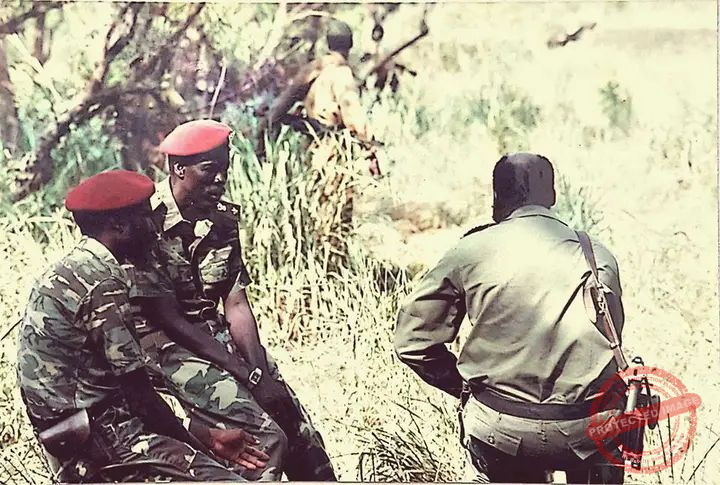
SPLA Commanders (L-R): Deputy Chief of Staff Salva Kiir, Chief of Staff William Nyuon Bany, and SPLM/A Chairman and Commander-in-Chief Dr. John Garang de Mabior. | Courtesy Photo.
For decades, the dream of South Sudan was carried by fighters in the bush, families in displacement camps, refugees abroad, and ordinary people who sacrificed everything in the struggle for freedom and nationhood.
When the flag of South Sudan was raised on July 9, 2011, the world witnessed the birth of Africa’s youngest nation. But behind the celebrations in Juba were years of suffering, sacrifice, betrayal, resilience, and hope.
The road to independence was not handed over freely. It was paid for in blood.
The war that shaped generations
The Second Sudanese Civil War erupted on May 16th 1983 after the government in Khartoum imposed Islamic Sharia law and tightened control over the south.
For many southerners, it marked the continuation of decades of political exclusion, economic neglect, and cultural domination.
Out of the conflict emerged the Sudan People’s Liberation Movement and its military wing, the Sudan People’s Liberation Army, under the leadership of John Garang de Mabior.
At the beginning, Garang did not call for separation. His vision was a “New Sudan” built on equality, secularism, and justice. But as the war intensified, many southerners came to believe that full independence was the only path to dignity and survival.
Villages were bombed. Families fled their homes. Hunger and disease spread across the south. Millions became refugees in Uganda, Kenya, Ethiopia, and the Democratic Republic of Congo.
An entire generation grew up surrounded by war.
Civilians carried the struggle
While commanders and politicians often dominated public attention, ordinary civilians carried the liberation struggle on their backs.
Communities gave food to fighters even during famine. Families donated cattle, a symbol of wealth and survival in many South Sudanese cultures, to sustain the movement.
Women walked long distances carrying supplies through dangerous areas controlled by enemy forces.
Thousands of children lost access to education. Many became orphans, while others joined the war effort as recruits, messengers, or porters.
In villages across the south, civilians hid SPLA fighters from government attacks. Elders organized local defense groups, while religious leaders encouraged communities to remain resilient.
Traditional songs slowly became songs of resistance.
The liberation struggle became a people’s struggle.
The bush fighters and the cost of war
SPLA fighters lived under harsh conditions in forests, swamps, and hostile territories for years. Many lacked food, medicine, and proper military equipment.
Yet they continued fighting in one of Africa’s longest and deadliest civil wars.
Some died in remote battlefields that were never documented. Others disappeared during ambushes and aerial bombings.
Among the most painful symbols of the war was the “Red Army,” thousands of boys separated from their families during the conflict. Many endured hunger, exhaustion, and displacement while moving across borders in search of protection and military training.
Despite the suffering, the movement gradually became a powerful political and military force that pushed the Sudanese government toward negotiations.
Katiba Banat: The women behind the struggle
Women also played a major role in the liberation struggle through Katiba Banat, meaning “Girls’ Battalion.”
Some women received military training and carried arms. Others served as medics, cooks, mobilizers, messengers, and caregivers for wounded soldiers and displaced civilians.
Among the women associated with the liberation struggle and women’s mobilization in 1983 were Ager Gum, Rebecca Nyandeng de Mabior, Nyandeng Kerubino Kuanyin, Ayen Mayardit, Ayaa Benjamin Warrille, Awut Deng Acuil, Josephine Lagu, Mary Apayi Ayiga Wani, Mary Boyoi, Aguil Achut Deng, Amel Madut Aluk, and Amuol Aman.
Later, between 1984 and 1985, another group under the battalion known as Koryom or Rhino joined the movement at the ages of 14 to 18. They included Nyankiir Atem, Martha Aluel Ayei, Aker Deng Ayom, Agum Atem, Abeny Anei, Yar Paul Keah Wang, Nyandur Bior, Akuek Achiek, Bonguot Amum, and Mama Celina.
In the bush, these women endured hunger, displacement, bombings, and the loss of family members. Yet many remained committed to the liberation cause and helped sustain communities during some of the darkest years of the conflict.
Despite their sacrifices, many of their stories remain undocumented and underrecognized.
Today, Katiba Banat remains a symbol of the courage and resilience of South Sudanese women whose contributions were vital to independence.
Intellectuals and diaspora activism
Beyond the battlefields, South Sudanese students and intellectuals abroad also became part of the struggle.
Late Bona Malwal used journalism and diplomacy to advocate for Southern Sudanese rights. Francis Mading Deng promoted the rights and identity of Southern Sudanese people through academia and diplomacy.
Others included Nhial Bol, Professor Peter Adwok Nyaba, James Wani Igga, Lam Akol Ajawin, Pagan Amum, Deng Alor Kuol, Akol Miyen Kuol, and John Andruga Duku.
In universities across Kenya, Uganda, the United States, the United Kingdom, and Australia, many unnamed South Sudanese students organized demonstrations, fundraising campaigns, and lobbying efforts to support the call for self-determination.
Diaspora communities also raised donations for refugees and documented human rights abuses during the war.
For many students abroad, education itself became part of the liberation struggle.
The road to peace
As the war dragged on, regional and international pressure increased.
The Intergovernmental Authority on Development led mediation efforts, while Kenya hosted peace talks between the Sudanese government and the SPLM/A.
The United Nations, the African Union, aid agencies, faith-based organizations, and human rights groups also highlighted the suffering of southern civilians.
After years of negotiations, the breakthrough came on January 9, 2005, when the Sudanese government and the SPLM/A signed the Comprehensive Peace Agreement in Naivasha, Kenya.
The agreement ended more than two decades of war and granted Southern Sudan autonomous governance for six years, followed by a referendum on independence.
For many South Sudanese, the CPA was proof that decades of sacrifice had not been in vain.
The death of John Garang
Only months after the signing of the CPA, tragedy struck.
On July 30, 2005, John Garang de Mabior died in a helicopter crash while returning from Uganda.
His death triggered grief and uncertainty across Sudan.
To many South Sudanese, Garang had become the face of liberation. His death left a major leadership vacuum within the movement.
Leadership of the SPLM later transitioned to Salva Kiir Mayardit, who oversaw the independence process.
The referendum that changed history
In January 2011, millions of southern Sudanese lined up in villages, towns, and refugee camps to vote in the independence referendum promised under the CPA.
Some walked for days to cast their ballots.
Others voted while remembering relatives lost during the war.
The result was overwhelming. Nearly 99 percent voted for secession from Sudan.
It became one of the clearest expressions of collective political will in modern African history.
Independence and rising expectations
On July 9, 2011, South Sudan officially became the world’s newest nation.
Crowds celebrated in Juba, Wau, Malakal, and other towns. Traditional dancers performed as church bells rang across communities.
The South Sudan flag rose as the Sudanese flag came down.
For many citizens, independence brought hope for roads, schools, healthcare, security, and democratic governance.
The dream had finally arrived.
But peace did not last long.
Conflict after liberation
Soon after independence, divisions within the ruling SPLM began to widen.
Political rivalries, ethnic tensions, accusations of corruption, and competition for power intensified.
The movement that had united against a common enemy struggled to transform itself into a stable democratic government.
Differences between President Salva Kiir Mayardit and his former deputy Riek Machar escalated into violent conflict in December 2013 and again in 2016.
Violence erupted in Juba before spreading to other parts of the country.
Thousands were killed, while millions were displaced once again.
Communities that had once fought together during liberation turned against each other.
The conflict shattered much of the optimism that came with independence.
An unfinished struggle
Since 2013, South Sudan has continued facing political instability, economic hardship, humanitarian crises, flooding, hunger, and repeated peace negotiations.
Regional bodies such as the Intergovernmental Authority on Development and the African Union continue mediation efforts, while the United Nations Mission in South Sudan remains involved in civilian protection and peace support.
Yet despite the setbacks, many South Sudanese still believe in the promise of the country they fought so hard to build.
Young people continue calling for reforms. Civil society groups advocate for justice and accountability. Religious leaders preach reconciliation.
Artists, journalists, academics, and activists continue pushing for a better future.
South Sudan’s independence was not a gift from foreign powers. It was built through decades of sacrifice by ordinary people whose names may never appear in official records.
It belongs to widows who buried their loved ones during war.
To refugees who crossed borders carrying children on their backs.
To soldiers who died in swamps and forests believing future generations would live in peace.
To students who defended the southern cause in foreign classrooms.
And to civilians who surrendered everything for freedom.
The tragedy of South Sudan is not that independence was achieved. The tragedy is that many of the ideals behind it remain unfinished.
Yet despite conflict and disappointment, the story of South Sudan remains one of the most remarkable struggles for self-determination in modern African history, a reminder that winning freedom is one battle, but building a nation is another.
Currently on air
13:00:00 - 13:30:00
 1
1Published May 12, 2026
 2
2 3
3Published May 14, 2026
 4
4Published May 11, 2026
 5
5Published May 12, 2026
 6
6Published May 12, 2026
 7
7Published May 14, 2026
 8
8Published May 14, 2026
Published 30 minutes ago

Published 1 hour ago
Published 20 hours ago
Published 22 hours ago
Published 23 hours ago

Published May 16, 2026
Support Eye Radio, the first independent radio broadcaster of news, information & entertainment in South Sudan.
Make a monthly or a one off contribution.
Copyright 2026. All rights reserved. Eye Radio is a product of Eye Media Limited.