
3rd March 2026
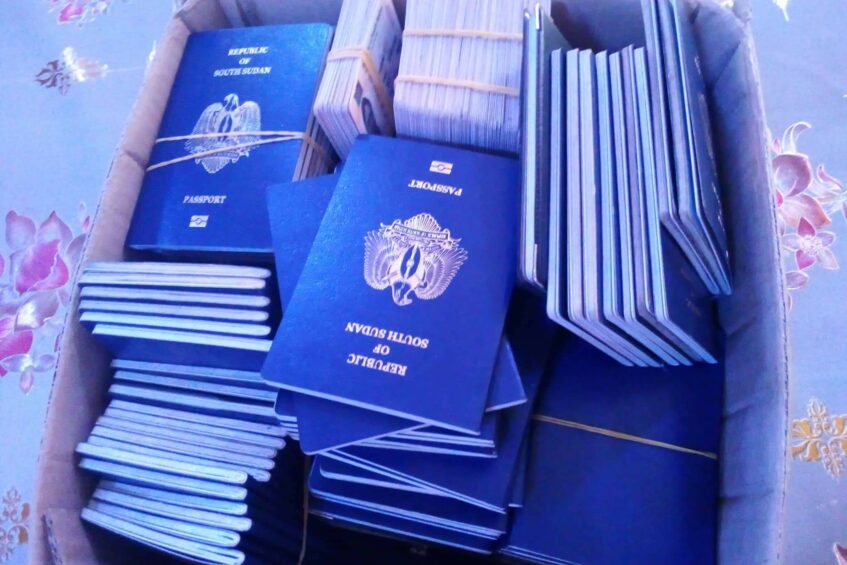
South Sudanese Passport booklets| File photo
JUBA, South Sudan (Eye Radio) – The Director General of Nationality, Passports, and Immigration has shed light on the types of South Sudanese citizenship and the detailed procedures required to obtain them, addressing growing public concerns about foreigners allegedly acquiring national documents through illegal means.
Speaking to Eye Radio on Friday, October 17, Major General Elia Costa Faustino explained that there are three main legal pathways to obtain South Sudanese citizenship: by birth, by marriage, and by naturalization.
The Director General stated that citizenship by birth is automatically granted when both parents are South Sudanese. He clarified that the nationality law also provides for citizenship through the mother when the father is not South Sudanese.
“The first is citizenship by birth when you are from a South Sudanese father and mother. There is no separate citizenship through the father, but naturally, if your father holds South Sudanese citizenship, you are a South Sudanese,” Maj. Gen. Costa said.
He added that in cases where the mother is South Sudanese and the father is a foreigner, the child still has the right to apply for South Sudanese citizenship, noting that applicants in such cases must go through an eligibility committee within the Department of Nationality and Passports.
Maj. Gen. Costan stated that he process involves presenting a legal declaration from a court, attending interviews with a relative or guardian, and undergoing background investigations to verify all information provided.
“You have the right to obtain citizenship by following the established procedures. After investigation and confirmation of the facts, the committee can approve citizenship through the mother,” he said.
The Director General went on to explain that citizenship can also be obtained through marriage to a South Sudanese national.
He stated that to qualify, the couple must present a valid marriage certificate, whether from a church, mosque, customary court, or Civil Court, along with the children’s birth certificates, if available.
However, he cautioned that this type of application is lengthy and complex, as it involves additional scrutiny from the eligibility committee.
Maj. Gen. Costa further warned of cases where foreign men marry South Sudanese women merely to obtain citizenship and later divorce them.
“It is somewhat different from citizenship through the mother; here, the procedures are more complicated and involve several stages of verification. Some men try to get South Sudanese citizenship through marriage, but once they obtain it, they divorce,” he said.
“We have measures to control this. If you divorce the woman after two or three years, we can summon you and even withdraw your citizenship because the purpose was not genuine marriage but obtaining nationality fraudulently.”
Maj. Gen. Costa confirmed the third type is citizenship by naturalization, which is open to foreigners who have legally resided in South Sudan for several years and meet the requirements stipulated in the law.
He clarified that the law allows naturalization through marriage, where a foreigner married to a South Sudanese woman can apply for citizenship after five years.
According to Maj. Gen. Costa, after completing the required procedures, the application passes through a series of approvals, starting with the Department of Nationality and Passports, then moving to the Director of Civil Registry, the Inspector General of Police, and finally to the Minister of Interior, who gives the final endorsement.
Responding to allegations from citizens that foreigners sometimes obtain national documents easily, the Director General assured the public that the process is thorough and transparent.
“Many times, people ask accusingly how foreigners obtain South Sudanese passports or nationality certificates. I want to assure everyone that no foreigner gets citizenship without following the procedures provided by law,” he stated.
He emphasized that applications are normally reviewed by multiple institutions before approval, noting that applications go through a chain of administrative and security clearances before any document is issued.
“All the security units are present in the immigration office, and every application passes through them. Is it reasonable that all these agencies would approve citizenship without entitlement?” he asked.
“After completing the procedures, the papers are passed through several offices: first to the Director of Nationality, then to the Director General of Civil Registry, Nationality, and Passports, the Inspector General of Police, and finally to the Minister of Interior.”
The Director General urged South Sudanese citizens to familiarize themselves with the country’s citizenship laws and the due process involved in obtaining nationality documents.
He noted that misinformation and lack of awareness often fuel public suspicion.
“Some people do not see these procedures; they only see the foreigner obtaining citizenship. But behind every case are multiple layers of checks and investigations to ensure legality and fairness,” he said.
He reaffirmed the government’s commitment to upholding the integrity of South Sudanese citizenship, saying the department remains vigilant against forgery, corruption, and misuse of marriage or family ties to gain nationality status.
The Director General concluded by encouraging South Sudanese to trust the system and to report any suspected cases of fraudulent citizenship acquisition.
“We are working to make sure that every person who carries a South Sudanese passport or nationality certificate truly deserves it,” he said.

Currently on air
00:00:00 - 06:00:00
 1
1Published February 28, 2026
 2
2Published March 1, 2026
 3
3Published February 25, 2026
4Published February 24, 2026
 5
5Published 13 hours ago
Published 9 hours ago
Published 9 hours ago

Published 11 hours ago
Published 12 hours ago

Published 12 hours ago
Published 13 hours ago
Support Eye Radio, the first independent radio broadcaster of news, information & entertainment in South Sudan.
Make a monthly or a one off contribution.
Copyright 2026. All rights reserved. Eye Radio is a product of Eye Media Limited.