
20th February 2026
You are here: Home | National News | News | Peace | Peace parties clash over ‘unconditional release’ wording in RJMEC draft
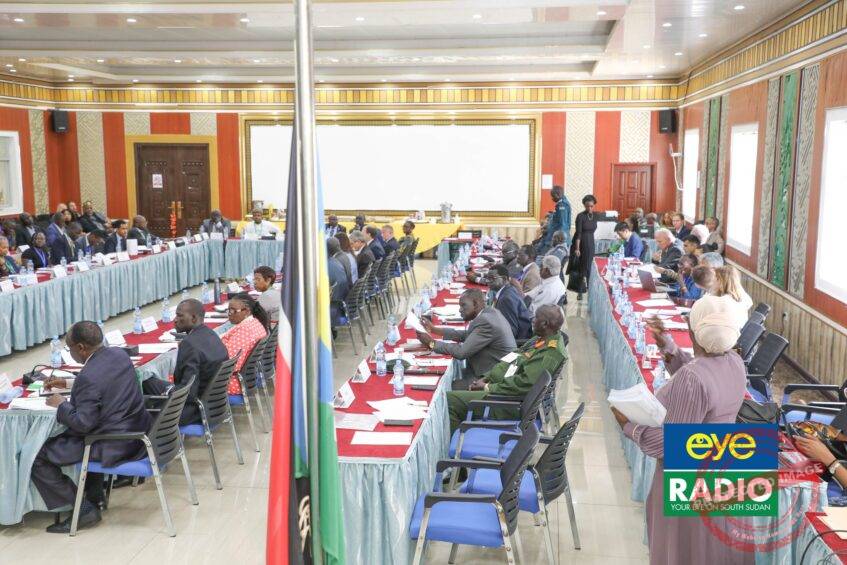
RJMEC Tuesday's extraordinary meeting|Courtesy|By Awan Moses
Some parties in the unity government have called for the removal of the phrase “unconditional release” from a draft RJMEC communiqué, arguing it undermines ongoing judicial processes, while SPLM-IO representatives have urged for the language to be revised, not scrapped, to reflect a spirit of dialogue and reconciliation.
SPLM representatives and allied parties argued that those referred to are already on trial and should not be described as detainees, while SPLM-IO delegates pushed for revising the language instead of removing it entirely.
The debate began when Nadia Arop Dudi, representing the SPLM in government, took issue with a paragraph in the draft urging the unconditional release of SPLM-IO members in detention.
“My concern is the language used here, ‘unconditionally release all SPLM-IO detainees’ and ‘embrace dialogue’, since those referred to are no longer detainees because they are in court,” said Dudi. “The wording is important, but it should be moved under the section that speaks about dialogue.”
Justice Minister Dr. Joseph Geng Akech strongly supported her stance, insisting that judicial matters were outside RJMEC’s mandate and should not be addressed in the communiqué.
“We have said, and I think this is well established, that judicial proceedings would not be brought to the public discourse. So, these parts should be expunged completely from the unconditional release all the way should be expunged,” said Geng. “
These parts should be expunged completely. When a matter is in court, no party is allowed to intervene unless they are involved in the proceedings. To call for unconditional release here is inappropriate and should be removed entirely.”
However, SPLM-IO and Former Detainees (FDs) delegates challenged the government’s position.
SPLM-IO representative Yolanda Ayuel urged the plenary to revise the language instead of removing the entire section.
“I agree it can be transferred to another section, but we shouldn’t lose sight of what needs to be captured here,” said Yolanda.
“This is not business as usual — it’s a complex situation. Instead of scrapping the paragraph, why don’t we paraphrase it in a way that conveys the message without undermining legal processes?”
Dr. Geng doubled down, warning that the wording disrespected South Sudan’s judiciary.
“If R-JMEC is suggesting that courts stop judicial proceedings and release the accused, then that is outside its mandate,” he said.
“Dialogue does not mean stopping court cases — that’s a political decision. Referring to accused individuals as ‘detainees’ is, to be polite, disrespectful to the judiciary.”
A civil society activist supported Yolanda’s remarks, warning that removing the paragraph altogether risked ignoring broader concerns about arbitrary arrests and the shrinking of civic and political space.
“We don’t have to be so specific, but we must not forget the issue of arbitrary arrest and harassment,” the FD representative said.
“Regardless of political affiliation, South Sudanese being held unjustly should be released. That should be clearly reflected in this document.”
Minister of Cabinet Affairs Dr. Martin Elia Lomuro backed the Justice Minister, emphasizing that RJMEC’s role is strictly advisory and should avoid politically sensitive language.
“Dialogue is the right term,” said Lomuro. “If I were you, I would stop at the mention of arrest and detentions and leave the rest. This is where dialogue begins. We shouldn’t be seen as directing the President or making political statements.”
After nearly 30 minutes of deliberations, members reached a consensus to remove the references to “unconditional release” and “detainees,” while retaining broader language around the importance of dialogue and reconciliation.
Before the session ended, UK Ambassador to South Sudan, David Ashly, proposed adding a reference to the suffering and loss of life experienced by civilians due to the current political and security challenges.
The suggestion was accepted by the plenary.
RJMEC Chairperson Ambassador George Owino closed the session by commending members for their honest and constructive engagement.
“We will capture all additions and subtractions to the draft so it can be adopted,” said Owino. “With those adjustments, the draft resolution is adopted.”
The revised communiqué now emphasizes the importance of dialogue and accountability while steering clear of language that could interfere with ongoing judicial proceedings, as South Sudan’s leaders continue to face pressure to fully implement the 2018 Revitalised Peace Agreement.

Currently on air
09:00:00 - 12:55:00
 1
1Published February 16, 2026
 2
2Published February 14, 2026
 3
3Published February 13, 2026
 4
4Published February 15, 2026
 5
5Published February 16, 2026
Published 16 hours ago
Published 16 hours ago
Published 17 hours ago

Published 17 hours ago
Published 18 hours ago
Published 19 hours ago
Support Eye Radio, the first independent radio broadcaster of news, information & entertainment in South Sudan.
Make a monthly or a one off contribution.
Copyright 2026. All rights reserved. Eye Radio is a product of Eye Media Limited.