
21st August 2026
You are here: Home | Crime and law | Culture | National News | News | Thirty community leaders undergo training on women’s rights, protection in Juba
Michael Daniel|Courtesy
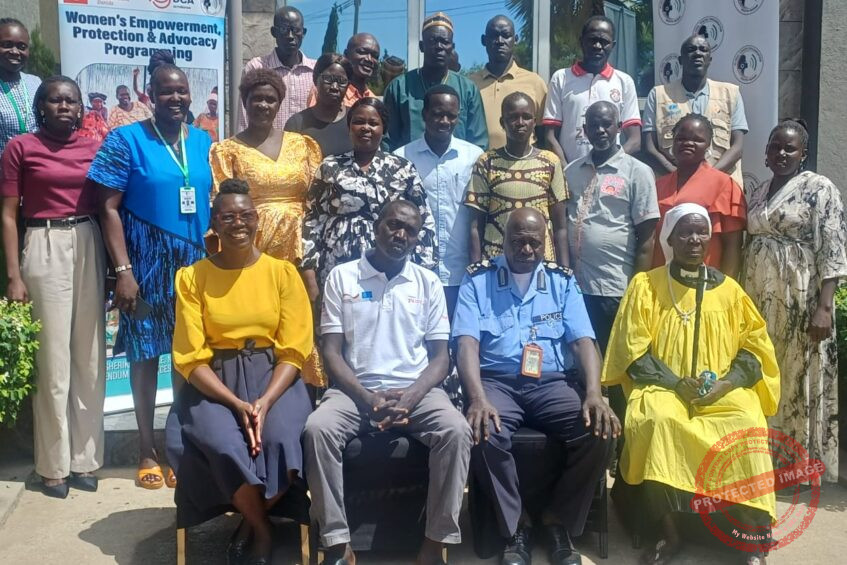
Thirty community leaders, including nine women, have begun a three-day training in Juba aimed at strengthening knowledge of women’s rights, prevention of gender-based violence, and referral mechanisms for survivors of abuse.
The workshop has brought together 21 traditional chiefs and nine women leaders to enhance understanding of women’s legal entitlements, land rights, national and international protection frameworks, and community justice systems.
Organizers say the initiative seeks to tackle gender inequality, harmful cultural practices, and persistent cases of gender-based violence affecting women and girls across South Sudan.
Speaking during the opening session, Executive Director of Global Voices Organisation South Sudan, Josephine Chandiru Drama, said the training would provide traditional leaders and women representatives with practical knowledge to support women’s protection within their communities.
“The main purpose of these three days training is to equip the chiefs and traditional leaders to support women’s protection issues in communities, to understand that women have rights and entitlements that are constitutionally mandated for them to acquire, control and own land,” Drama said.
She said participants would receive training on legal instruments including the Transitional Constitution, the Land Act, the Maputo Protocol, and the Convention on the Elimination of All Forms of Discrimination Against Women (CEDAW).
Drama noted that the training would also help traditional leaders understand the limits of their jurisdiction and strengthen referral systems for survivors of abuse.
“We will be sharing with them to understand their jurisdiction so that they know which cases they are able to handle and then they are able to also refer cases that are beyond their mandate,” she said.
According to Drama, chiefs will be equipped to identify cases requiring referral to police, courts, and service providers, while also developing community bylaws to address protection concerns affecting women and girls.
Director of the Special Protection Unit at the Ministry of Interior, Brigadier James Dak Carlo, described traditional chiefs as key partners in preventing and responding to gender-based violence due to their close relationship with local communities.
Dak urged citizens to report cases of rape, defilement, domestic violence, and assault instead of concealing them because of cultural beliefs or stigma.
“They live with the community, they know who the criminals are and they know how they can eradicate the cases of gender-based violence,” Dak said. “If we don’t report, the law will not take a stand. For us to pin down the perpetrator, we have to report.”
He said chiefs can play an important role in encouraging reporting and working alongside organized forces to address violence against women and children.
Dak also called for stronger implementation of legal instruments protecting women’s rights, including the Maputo Protocol and United Nations Security Council Resolution 1325.
“We want the government to implement it fully. We also want the Family Bill to be passed before the election,” he said.
Meanwhile, Chief Lafayee Matit Malondo of Coroyu said the training would help participants serve as community paralegals capable of educating citizens about laws and human rights.
“In these three days that we will spend here, we will become paralegals. We will know the laws which guide us and guide our communities and we will educate all the young people so that they should know what is right and what is wrong,” Malondo said.
He urged communities not to conceal perpetrators of rape and other serious crimes, saying justice can only be achieved when cases are reported through the proper channels.
“If the woman is raped, according to other people’s cultures, they can even hide it. It is a capital crime and it should be reported to the chief, the chief will report it to the police and then the court will take its course,” he said.
Malondo also appealed to communities and families to support the rehabilitation of offenders, noting that correctional facilities are intended to reform individuals and facilitate their reintegration into society.
The workshop is supported by Danish Church Aid and Global Voices Organisation South Sudan as part of ongoing efforts to strengthen community protection systems and improve access to justice for survivors of abuse.
By Michael

Currently on air
00:00:00 - 06:00:00
 1
1Published August 16, 2026
 2
2Published August 18, 2026
 3
3Published August 16, 2026
 4
4Published August 17, 2026
 5
5Published August 19, 2026
 6
6Published August 19, 2026
 7
7Published August 17, 2026
 8
8Published August 14, 2026
Published 5 hours ago

Published 11 hours ago

Published 13 hours ago

Published 13 hours ago

Published 13 hours ago
Support Eye Radio, the first independent radio broadcaster of news, information & entertainment in South Sudan.
Make a monthly or a one off contribution.
Copyright 2026. All rights reserved. Eye Radio is a product of Eye Media Limited.