
7th July 2026
You are here: Home | Humanitarian | News | South Sudan: ICRC evacuations of wounded patients rise by more than half amid renewed fighting
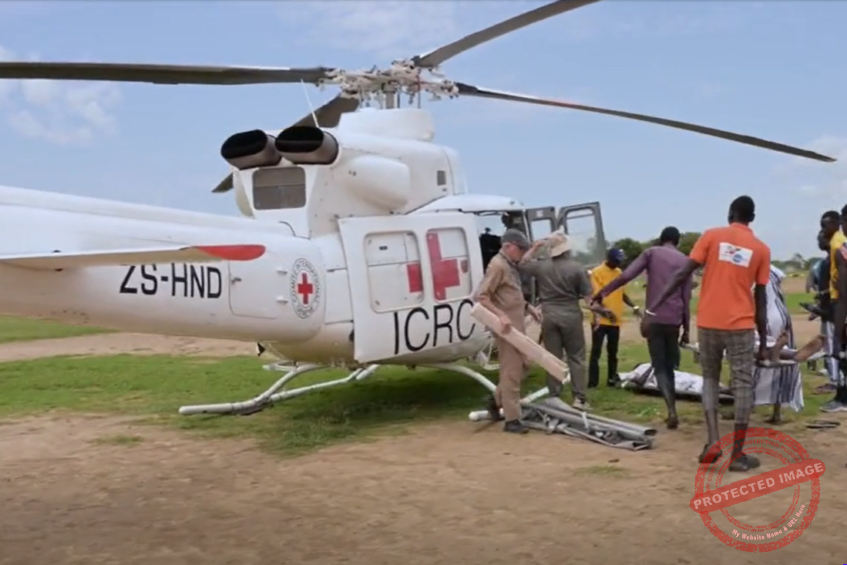
FILE PHOTO: An International Committee of the Red Cross (ICRC) helicopter at Ganyliel Airstrip in Panyjiar County, Unity State, during a humanitarian mission to evacuate wounded patients for urgent medical treatment. — Courtesy of ICRC
The International Committee of the Red Cross (ICRC) evacuated 266 wounded patients across South Sudan during the first six months of 2026, an increase of more than 50 per cent compared with the same period last year, as renewed fighting placed growing pressure on trauma services.
According to a statement issued by the ICRC, the increase in medical evacuations comes amid escalating conflict and violence since late 2025, and caused thousands of families to flee their homes, lose their livelihoods and safe access to health-care. The fighting also led to significant loss of life and injuries, increasing demand for life-saving care.
As South Sudan marks 15 years of independence, humanitarian needs are deepening, fuelled by conflict, violence and insecurity, climate-related shocks, and arrivals of people fleeing conflict in neighbouring Sudan. Meanwhile, shrinking funds to help those in need means many are left without much-needed assistance.
“Conflict is not getting any better and the humanitarian needs are also on the rise. This is further complicated with the fact that the funding has gone down. So, service provision at all levels of health-care is reduced, and this causes a lot of strain in the hospital levels,” explained Rose Ochieng, ICRC health coordinator in South Sudan.
Since 2014, more than 5,000 patients have been evacuated by the ICRC for life-saving surgical care across South Sudan. The majority of patients are transported by air from across the country to Juba Military Hospital, one of South Sudan’s main trauma referral centres, where surgeries in the first half of the year increased by nearly 30 per cent compared with the same period in 2025. As a result, the ICRC-supported surgical department is consistently operating at more than 100 per cent capacity.
One of those patients is Ngor Gatluak, who was evacuated from Agany, a remote area in Jonglei state, around 420km from Juba. “I was shot in my arm during one of the battles. There is no hospital in our area, so I was taken from Agany for treatment. I was later referred to this hospital. I am feeling much better now, and I hope to return home soon”, he said.
Access to life-saving health-care remains severely limited in many parts of the country. In areas where fighting is recurrent, including remote regions where mobile connectivity is intermittent and roads are poor, individuals and communities struggle to reach health facilities. The pressure on trauma care extends beyond evacuations; to referral systems, surgical services, rehabilitation, mental health and follow-up care, while national capacity to provide these services is under growing strain.
Fifteen years after independence, the priority is to ensure that people in need of life-saving surgical care can access it, regardless of who they are or where they come from. The ICRC will continue to work alongside health authorities and partners, especially the South Sudan Red Cross (SSRC), to ensure that life-saving care remains accessible to those affected by conflict.
The ICRC calls on all parties to the conflict to uphold their obligations under international humanitarian law, to respect and protect health-care workers and medical facilities, to take all possible measures to collect and evacuate the wounded and sick without adverse distinction. They must also ensure access to life-saving medical care without obstruction, and allow and facilitate the rapid and unimpeded passage of humanitarian assistance to civilians in need.
Since 2014, almost 9,000 weapon-wounded patients have been admitted for treatment in ICRC-supported surgical facilities across South Sudan, receiving life-saving and specialized trauma care.
ICRC surgical teams have performed more than 29,000 life- and limb-saving surgeries through a combination of fixed surgical facilities and Mobile Surgical Team deployments, bringing specialized trauma care closer to people affected by armed conflict while maintaining referral capacity for complex cases.
More than 5,000 weapon-wounded patients have been safely transferred from conflict-affected areas across South Sudan to access emergency surgery, specialized treatment, physical rehabilitation, and mental health and psychosocial support.
Between 2014 and 2025, nearly 40,000 persons with disabilities accessed essential physical rehabilitation services through ICRC-supported centres in Juba, Wau, and Rumbek, helping people regain mobility, independence, and social inclusion.
Currently on air
09:00:00 - 12:55:00
 1
1Published July 5, 2026
 2
2Published July 3, 2026
 3
3Published July 1, 2026
 4
4Published July 6, 2026
 5
5Published 22 hours ago
 6
6Published July 3, 2026
 7
7Published July 3, 2026
 8
8Published July 1, 2026

Published 5 minutes ago

Published 32 minutes ago
Published 1 hour ago

Published 2 hours ago
Published 2 hours ago
Support Eye Radio, the first independent radio broadcaster of news, information & entertainment in South Sudan.
Make a monthly or a one off contribution.
Copyright 2026. All rights reserved. Eye Radio is a product of Eye Media Limited.