
14th August 2026
You are here: Home | Governance | Media | National News | News | Media houses seek dialogue over one-month license renewal deadline
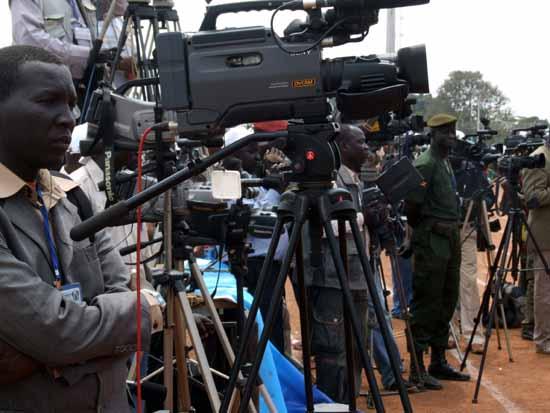
A picture of journalists in the Capital, Juba covering an event. Photo credit: Courtesy
South Sudanese media stakeholders are calling for dialogue with the Media Authority over the renewal of expired operational licences, citing increased fees and the difficult economic conditions facing media houses.
The Media Authority has given radio stations, newspapers, online media outlets, television channels and other registered media entities one month to renew their expired licences.
In a notice dated August 14, the authority said a substantial number of radio stations had failed to renew their operational licences, with some reportedly operating for six years or more without valid licences.
“Some stations have reportedly operated for six years or more without valid operational licenses,” the notice stated.
The authority urged affected media houses to begin and complete the renewal process in accordance with applicable laws and regulatory requirements.
Speaking to Eye Radio, Chief Executive Officer of Community Radio, Chris Marol, said media houses were surprised by the one-month notice and cited increased licensing fees as a major challenge.
“One of the bigger obstacles is basically the fees have been increased significantly and that has been a big challenge for us,” Marol said.
He called for discussions between media houses and the Media Authority to find solutions to the licensing issue.
“What we will need to see is basically to have a conversation with the media authority so that we can be able to find a workable solution to resolve this media house individually,” he said.
Editor-in-Chief of the Catholic Radio Network, Chuol Jany Bol, said media institutions want to operate with valid licences but face difficulties meeting the increased fees.
“Nobody or no media institution would like to operate illegally without having a license,” Bol said.
He said the operational licence fee increased from about 370,000 South Sudanese pounds in 2024 to around 3.5 million pounds in 2025.
Bol said more than 90 media houses, including the South Sudan Broadcasting Corporation, have reportedly been unable to meet the licensing requirements.
Keden Estella Mandela, Editor-in-Chief of Number One Citizen’s Newspaper, said the economic situation was making it difficult for media houses to meet regulatory requirements.
“Based on the economic situation the country is going through, even sustaining it is becoming very difficult at the moment,” Mandela said.
She said her newspaper had been unable to raise the money required for its licence and that subscription revenue remained low.
Meanwhile, Eye Media Chief Executive Officer Stephen Omiri called for dialogue between media houses and the Media Authority, saying the one-month deadline was too short.
“What we are asking currently is dialogue to be able to talk with the media authority,” Omiri said.
He said community media play an important role in providing information during emergencies, disease outbreaks, conflict and periods of misinformation.
“We want to remain compliant, but also we would like them to understand the financial situation we find ourselves in currently,” Omiri said.
He added, “The notice is very short. One month is very short.”

Currently on air
18:00:00 - 18:55:00
 1
1Published August 9, 2026
 2
2Published August 8, 2026
 3
3Published August 9, 2026
 4
4Published August 10, 2026
 5
5Published August 10, 2026
 6
6Published August 11, 2026
 7
7Published August 8, 2026
 8
8Published August 12, 2026

Published 33 minutes ago

Published 48 minutes ago
Published 56 minutes ago

Published 1 hour ago
Published 2 hours ago
Published 2 hours ago
Support Eye Radio, the first independent radio broadcaster of news, information & entertainment in South Sudan.
Make a monthly or a one off contribution.
Copyright 2026. All rights reserved. Eye Radio is a product of Eye Media Limited.