
19th August 2026
You are here: Home | Governance | Humanitarian | National News | News | Gov’t, UN set 2026 resettlement target after assisting 28,000 since January
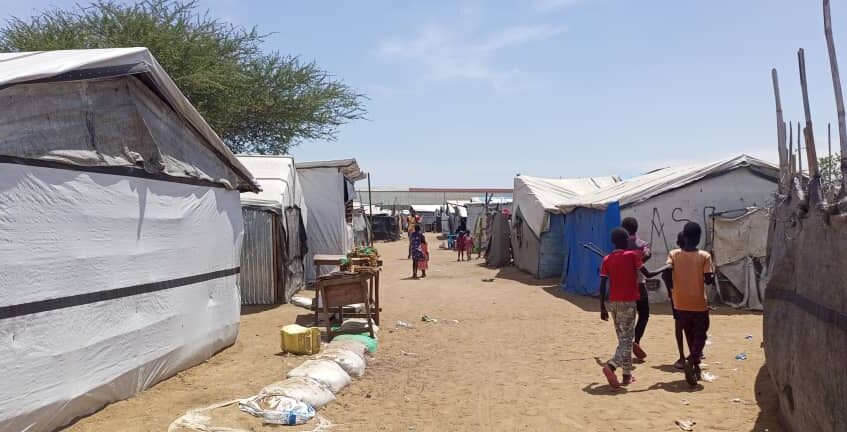
Side view of Mangateen IDPs Camp as of Monday, 29th May 2023. Photo Credit: Charles Wote/Eye Radio.
The Government of South Sudan and the United Nations have pledged to end displacement for 60,000 citizens by the end of 2026. The announcement follows the assistance of 28,000 internally displaced persons (IDPs), returnees, and refugees since January.
The statement was issued during the second Steering Committee Meeting on Durable Solutions in Juba on Monday, June 15. The forum brought together national ministers, state authorities, UN representatives, and humanitarian organizations to review progress since 13 ministries signed a communiqué on durable solutions in January.
Humanitarian Affairs Minister Albino Akol Atak stated that the strategy operates as a pilot project focused on Unity, Upper Nile, and Western Bahr el Ghazal states.
Across these regions, state-level roadmaps recorded the return, reintegration, or resettlement of the 28,000 individuals. This includes 13,000 people in Unity State on land reclaimed from flooding, 12,000 former camp residents in Western Bahr el Ghazal, and 3,400 people in Upper Nile State.
“The strategy is now being implemented from January up to this date. We have now almost five months. In the five months, we are able to assist 28,000 people to resettle, meaning that to take them away from the IDP camps,” Minister Atak said.
“This is a pilot project that will continue to cover the whole country. The other states that we have started in are three. Upper Nile State, Unity State and Western Bahr el Ghazal State,” he added.
Minister Atak explained that the initiative is designed to transition populations from dependence on aid toward self-reliance by establishing resettlement sites, including the Wedwil site in Northern Bahr el Ghazal State.
“The strategy is now being implemented from January up to this date,” Minister Atak said. “The only durable solution to their status is to reintegrate them, help them depend on themselves, and build their resilience. We have seen that we cannot continue giving humanitarian relief forever.”
Currently, more than 2.5 million people remain displaced across South Sudan, with 964,000 residing in camps due to conflicts dating to 2013, climate shocks, and the crisis in neighboring Sudan, which has driven 1.3 million people into the country since 2023.
Ramanathan Balakrishnan, the UN Resident and Humanitarian Coordinator ad interim, stated that stabilization requires cooperation.
“The commitment and engagement of the Government of South Sudan at all levels is indispensable for achieving durable solutions for its people,” Balakrishnan said. “Ultimately, peace and stability will be the foundations for building resilience, leading to pathways of development.”
The National Technical Committee on Durable Solutions oversees implementation, which is executed by state task forces led by the UN and non-governmental organizations. Current operations require interventions including landmine clearance, land restitution, legal aid, shelter construction, and the rehabilitation of services.
The Steering Committee will review progress toward the targets during the third quarter of 2026.
 1
1Published August 16, 2026
 2
2Published August 18, 2026
 3
3Published August 16, 2026
 4
4Published August 17, 2026
 5
5Published August 17, 2026
 6
6Published August 13, 2026
 7
7Published 8 hours ago
 8
8Published August 13, 2026

Published 4 hours ago
Published 4 hours ago

Published 4 hours ago
Published 4 hours ago

Published 5 hours ago
Support Eye Radio, the first independent radio broadcaster of news, information & entertainment in South Sudan.
Make a monthly or a one off contribution.
Copyright 2026. All rights reserved. Eye Radio is a product of Eye Media Limited.