
23rd July 2026
You are here: Home | Economy | Featured | National News | News | EAEP roundtable calls for stronger local content implementation in South Sudan’s oil sector

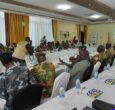
Panelists and moderators during roundtable discussion organized by Eastern Alliance Energy Platform (EAEP). Photo credit: Awan Moses/Eye Radio
The Eastern Alliance Energy Platform (EAEP) on Wednesday convened a high-level roundtable discussion that brought together government officials, policymakers, oil companies, financial institutions, and industry experts to assess the implementation of local content in South Sudan’s oil and gas sector and identify ways to address existing challenges.
Local content refers to policies that ensure a country’s citizens and businesses benefit directly from the exploitation of natural resources. In the oil and gas sector, it means giving priority to South Sudanese workers, companies, goods, and services in petroleum operations, while also building the skills and capacity of local people to participate meaningfully in the industry.
Held at the Nilepet Headquarters in Juba, the one-day forum attracted about 100 participants under the theme, “Local Content: Its Implementation and Constraints in the Oil & Gas Sector of South Sudan.”
The discussion focused on evaluating progress made in promoting local participation in the petroleum industry while exploring policy and regulatory reforms needed to expand employment and business opportunities for South Sudanese.
The event commenced with introductory remarks from the moderator and representatives of Nilepet and the Ministry of Petroleum.
Speaking during the opening remarks, Ayen Gregory, the Deputy Managing Director of Nilepet appreciated the EAEP for the roundtable discussion calling it a significant step towards oil and gas matters.
She said Nilepet will continue to support such engagements, saying empowering local content remains the only path to advancing South Sudan’s oil and gas agenda to the world market.
EAEP said the roundtable provided an opportunity for key stakeholders to exchange ideas, strengthen collaboration, and generate practical recommendations aimed at increasing local participation, creating more jobs, supporting South Sudanese businesses, and ensuring that the country’s petroleum resources contribute more effectively to national development.
Elijah Garang, the Co-founder and Executive Director of the EAEP applauded the panelists and the attendees, assuring that the event would continue to create awareness in oil and gas sector and help policymakers make a decision that benefits South Sudanese.
“The objective of this platform is to evaluate the activities of oil and gas, and then help to shape the policies through meaningful engagements,” Garang said.
During the first session, participants examined the concept of local content, its importance to the country’s economic development, international best practices, and South Sudan’s legal and policy framework governing the sector. Presentations were delivered by experts, legal representatives from the Ministry of Petroleum, and officials from the Ministry of Labour and Public Service.
The second session assessed the current state of local content implementation, with participants reviewing achievements made so far and discussing compliance by oil operators and contractors in creating employment opportunities for South Sudanese.
The discussion also highlighted the government’s role in promoting jobs and business opportunities for local companies within the oil and gas industry.
Representatives from commercial banks and the Bank of South Sudan explored ways to improve access to financing for local enterprises seeking to participate in the petroleum value chain, while other presentations focused on internship and graduate trainee programs as well as capacity-building initiatives aimed at strengthening the skills of the national workforce.
In the final session, stakeholders deliberated on the future of local content in South Sudan, emphasizing the need for policy and regulatory reforms to enhance local participation in the oil and gas sector.
Representatives from the Ministry of Petroleum, the Petroleum Oil and Gas Commission, the Bank of South Sudan, Nilepet, the technical fraternity, and the business community shared recommendations on strengthening the implementation of local content policies.
These include formation of a monitoring unit by the Ministry of Petroleum to over the implementation of the local content, enforce policies and regulate JOCs, in accordance with the laws of South Sudan.
The event also calls on the operation companies to empower and strengthen local engineers and technicians with skills required to fully implement the “South Sudanization Gas and Oil Policy in coming years.”
Local content has been a legal requirement in South Sudan’s petroleum sector since the enactment of the Petroleum Act, 2012, which requires petroleum contractors and subcontractors to give preference to qualified South Sudanese citizens in employment, training, and the procurement of locally available goods and services.
The law also encourages the transfer of technology and skills to build national capacity, with the long-term goal of enabling South Sudanese to play a greater role across the oil and gas value chain.
More than a decade after the law came into force, however, stakeholders say implementation has remained uneven due to gaps in enforcement, limited technical capacity, inadequate access to finance for local businesses, and the absence of comprehensive local content regulations.
As South Sudan prepares for the gradual transition of some international oil companies whose production-sharing agreements are expected to expire in the coming years, participants stressed that strengthening local content has become increasingly urgent.
They argued that investing in the skills of South Sudanese professionals, supporting local enterprises, and improving access to financing would position the country to sustain petroleum operations, retain more revenue within the national economy, and reduce dependence on foreign expertise beyond 2029.
With some petroleum contracts approaching expiry over the coming years, stakeholders said South Sudan should use the opportunity to strengthen local expertise and businesses so that nationals can assume a greater role alongside investors in the management and development of the country’s oil sector.
Eastern Alliance Energy Platform (EAEP) is a South Sudanese organization focused on promoting sustainable growth and participation in the country’s energy sector. Operating under the slogan “Energy for Today and Tomorrow,” the platform works to strengthen local content, build the capacity of South Sudanese professionals and businesses, facilitate dialogue among industry stakeholders, and advocate for greater national participation in the oil and energy industries. Through partnerships, research, training, and policy engagement, EAEP seeks to ensure that South Sudan’s natural resources contribute to long-term economic development and shared prosperity.

Currently on air
13:30:00 - 14:00:00
 1
1Published July 20, 2026
 2
2 3
3Published July 20, 2026
 4
4Published July 17, 2026
 5
5Published July 20, 2026
 6
6Published July 17, 2026
 7
7Published July 21, 2026
 8
8Published July 21, 2026

Published 1 hour ago

Published 2 hours ago

Published 2 hours ago

Published 3 hours ago

Published 4 hours ago
Support Eye Radio, the first independent radio broadcaster of news, information & entertainment in South Sudan.
Make a monthly or a one off contribution.
Copyright 2026. All rights reserved. Eye Radio is a product of Eye Media Limited.