
16th March 2026
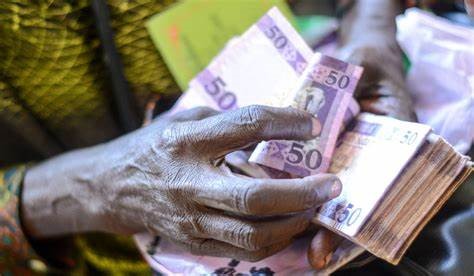
Man counts a bundle of 50 SSP notes. [Photo: ELRHA]
South Sudan’s real gross domestic product (GDP) stood at negative percent in the 2023-2024 fiscal year and will continue to plummet in the current financial year due to macroeconomic difficulties posed by the war in Sudan,” the International Monetary Fund said.
The conclusion was made after the third review under the Staff-Monitored Program with Board Involvement (PMB) held by IMF staff team led by Ms. Mame Astou Diouf, who visited Juba from September 25−October 2, 2024.
The Washington-based financial agency underscored that South Sudan’s deteriorating economic and humanitarian situation were partly caused by the impact of the Sudan war and recurrent flooding.
In February 2024, a major pipeline that carries about 70 percent of South Sudan’s oil exports from Upper Nile State to the north-eastern port of Sudan ruptured and has not been fully restored to operation.
In addition, the IMF stated that freight traffic in the Red Sea has further frustrated the oil exports due to increased insurance costs for the oil cargoes supplied through South Sudan’s other pipeline.
“Against this backdrop, South Sudan is estimated to have experienced an economic slowdown during the fiscal year 2023/24 (July 2023−June 2024), with a real GDP growth close to -6 percent, driven by the oil exports drop during the first half of 2024,” said the mission chief, Mame Astou Diouf.
“The slowdown is projected to continue during the fiscal year 2024/25 as the oil production shock persists. Economic prospects are expected to improve in the medium term as the effects of the shocks recede.”
Real Gross Domestic Product (GDP) is an inflation-adjusted measure that reflects the value of all goods and services produced by an economy in a given year.
According to financial experts, a decline in Real (GDP) signifies that the total economic output of a country has decreased when adjusted for inflation.
If such a decline in real GDP occurs over two consecutive quarters, it is often indicative of a recession, unemployment rates, reduced consumer confidence and investment slowdown.
The mission focused mainly on performance and policies underpinning the third review of the program, including the recent macroeconomic and policy developments, program performance, and near-term prospects and policy plans.
It noted that budget execution in the fiscal year 2023/24 proved challenging due to constraints posed by the pipeline rupture, despite a maximized oil revenue collection in December 2023.
It states that non-oil revenue increased following revenue administration measures and an adjustment in the exchange rate used for customs valuation.
“However, this only partially compensated for the drop in oil revenue. The pipeline damage also resulted in further salary payment arrears and increased monetary financing during the first half of 2024 to cope with the shock,” the IMF official stated.
Ms. Diouf further stated that the difference between the official and parallel foreign currency exchange (FX) value is wide, despite a recent stabilization of the official exchange rate.
She added that the massive depreciation of South Sudan currency by 222 percent between January and September 2024 was caused by reduced FX inflows and sporadic monetary financing to fund emergency needs.
The IMF team held meetings with the heads of South Sudan’s economic institutions, including Finance Minister Marial Dongrin Ater, Bank of South Sudan Governor James Alic Garang, and the Commissioner-General of South Sudan Revenue Authority, Africano Mande.
South Sudan is reportedly pursuing a broad-based macroeconomic policy readjustment aimed at tackling key challenges, including near-term adjustments of fiscal, monetary, and exchange rate policies to cope with the oil production shock.
Others are prudent macroeconomic policies to maintain economic stability and debt sustainability and reforms to further improve governance and transparency.
The agency representative further said, given the humanitarian situation, South Sudan will also work with development partners to continue supporting the vulnerable population and reduce food insecurity.
The PMB framework was developed by the IMF in 2022 to benefit countries that are subject to an ongoing concerted international effort by creditors or donors to provide substantial new financing or debt relief or have significant outstanding IMF credit under emergency financing instruments.
IMF staff-monitored programs are usually used when an IMF member country is not able to implement an IMF-supported program.

Currently on air
00:00:00 - 06:00:00
 1
1Published March 14, 2026
 2
2Published March 10, 2026
 3
3Published March 10, 2026
 4
4Published March 12, 2026
 5
5Published March 14, 2026
Published 12 hours ago
Published 12 hours ago

Published 14 hours ago

Published 14 hours ago
Published 15 hours ago

Published 16 hours ago
Support Eye Radio, the first independent radio broadcaster of news, information & entertainment in South Sudan.
Make a monthly or a one off contribution.
Copyright 2026. All rights reserved. Eye Radio is a product of Eye Media Limited.