
13th March 2026
You are here: Home | Crime and law | Governance | National News | News | Rights report warns of worsening repression; NSS dismisses claims as fear
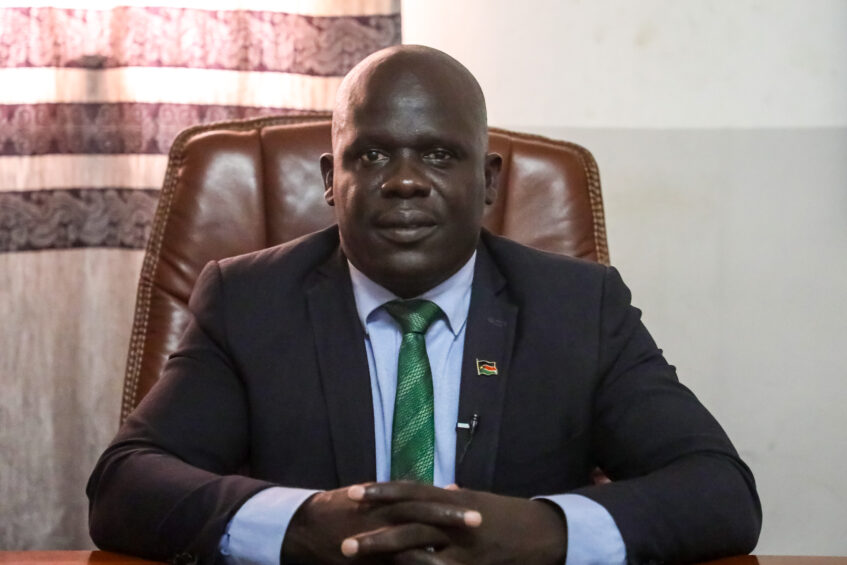
David John Kumuri, Spokesperson of the National Security Service. (Photo: Lou Nelson/Eye Radio).
A new civic space situation report has raised alarm over widespread violations of fundamental freedoms in South Sudan, documenting over 100 incidents of censorship, harassment, and arbitrary arrests targeting journalists, civil society actors, and human rights defenders between July 2022 and July 2025.
The report, released on Thursday by the South Sudan Human Rights Defenders Network (SSHRDN), details 114 cases of civic space violations across the country and warns that the deteriorating environment poses a serious threat to democratic participation—particularly ahead of the country’s first national elections since independence in 2011.
“These incidents reveal a deeply entrenched pattern of state and non-state actors deliberately curtailing civic freedoms,” the report states.
The violations, according to the report, were most prevalent in Central Equatoria, Upper Nile, and Lakes States, where civic engagement remains high but is increasingly met with state repression.
Documented abuses include the forced closure of media outlets, intimidation of journalists, arbitrary detentions, and, in some cases, enforced disappearances and deaths.
One case highlighted involved a radio station in Kapoeta being abruptly shut down by National Security Service (NSS) agents without explanation.
In another, a civil society leader in Bor reportedly fled into exile after multiple threats and attempted arrests.
The report, compiled by 15 trained monitors using interviews and secure digital tools, further reveals that at least 15 journalists were summoned by security agents for publishing content deemed critical of the government.
Some reported that their stories were censored or replaced entirely, while others had equipment confiscated during coverage of politically sensitive events.
Others described the national security as one of the most feared operatives in the country
In response to the report, David John Kumuri, Director of Public Relations and spokesperson for the National Security Service, dismissed the findings as exaggerated and said the agency remains committed to the protection of journalists and activists.
“Our obligation… is to make sure that our journalists are protected and a safe space is provided,” Kumuri said during a press briefing.
“We don’t protect the journalists fully unless they are isolated cases. But we have the mechanism of protecting our journalists from getting harassed, from intimidation, and from not accessing coverage.”
Kumuri characterized the reported violations as “isolated incidents” and accused some media and civil society actors of fueling “unnecessary fear” among the public.
“Let us cooperate with institutions… Why do you live in fear? Fear is one of the weapons of the devil,” he said.
“I believe reform is a process… We need to train our officers and NCOs. This is in the plan, in line with international conventions.”
He cited improved relations between NSS and the media in recent years and called for more collaboration between journalists and security institutions.
The report outlines a comprehensive set of recommendations, calling for an end to arbitrary arrests and surveillance of journalists and activists, the reform of the NSS Act to ensure civilian oversight and legal accountability, and the strengthening of media protections through the repeal of criminal defamation laws.
It also urges the introduction of court oversight for media shutdowns and digital censorship, as well as the creation of a National Protection Mechanism to safeguard human rights defenders and journalists.
Additionally, the report appeals to international bodies, including IGAD, the African Commission on Human and Peoples’ Rights, and the UN Special Rapporteur on Human Rights Defenders, to take urgent and coordinated action.
It also calls on international bodies like IGAD, the African Commission on Human and Peoples’ Rights, and the UN Special Rapporteur on Human Rights Defenders to take urgent action to address the repression and support protections for civic actors in South Sudan.
With South Sudan preparing for its first general elections
The SSHRDN also called on regional and international actors, including IGAD, the African Commission on Human and Peoples’ Rights, and the UN Special Rapporteur on Human Rights Defenders, to take urgent action to support civic actors and ensure accountability.
“Freedoms of expression, peaceful assembly, and independent media are essential prerequisites for free and fair elections,” the organization emphasized.
With South Sudan preparing for its first general elections since gaining independence, rights groups warn that the repression of civic actors could undermine the legitimacy of the vote and erode public trust in the democratic process.
The report’s release was attended by officials from the South Sudan Human Rights Commission, the Ministry of Parliamentary Affairs, and a number of civil society representatives and activists
Currently on air
00:00:00 - 06:00:00
 1
1Published March 6, 2026
 2
2Published March 6, 2026
 3
3Published March 8, 2026
 4
4Published March 8, 2026
 5
5Published March 10, 2026

Published 7 hours ago

Published 9 hours ago

Published 9 hours ago
Published 12 hours ago

Published 12 hours ago
Published 12 hours ago
Support Eye Radio, the first independent radio broadcaster of news, information & entertainment in South Sudan.
Make a monthly or a one off contribution.
Copyright 2026. All rights reserved. Eye Radio is a product of Eye Media Limited.