
2nd March 2026
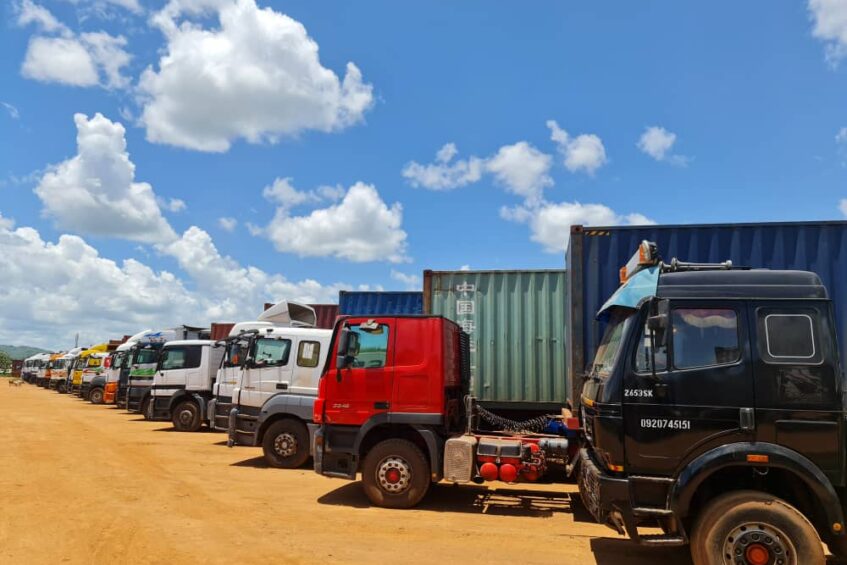
Trucks at the Nimule Customs yard | Credit | Deng Daniel
NIMULE, Eastern Equatoria (Eye Radio) – A new government directive requiring customs duties and clearance fees to be paid strictly in physical cash has triggered a massive backlog of commercial trucks at the Nimule border, the primary gateway for South Sudan’s imports.
Daniel Deng Ayuen, the President of the South Sudan Freight Forwarders Association (SSFFA), warned that the policy is disrupting regional trade, stalling cargo movement, and reversing years of progress toward digital banking reforms.
The directive, which reportedly took effect on February 19, 2026, forces importers and clearing agents to settle all customs obligations with physical currency. This move has specifically penalised businesses that have already transitioned to formal banking.
“The issue is that the government has ordered that the payment should be done in cash,” Ayuen told Eye Radio. “And here you are required to take the cash with the bank, and those who already have money in the bank are being denied to pay for the customs clearance.”
According to Ayuen, authorities justify the measure as a strategy to flush out cash held outside the formal economy. “The government assume that all the money is being kept by the business people outside the bank. So, in the letter that we have seen, there is a claim that this is another way of bringing the cash back to the bank,” he explained.
The sudden shift comes as a surprise to stakeholders, as the Council of Ministers and senior leadership have spent years advocating for a move away from manual payments to curb leakages and improve transparency.
“For several years, the government has been advocating that it wanted to encourage banking transactions and discourage the manual process of payment,” Ayuen noted. “But last week on the 19th of February, this won everything time. The usual process was that all the payments were due in the bank, whether from a bank transfer or an account-to-account transfer.”
The border is currently seeing only a trickle of movement, limited to those few transporters who were able to source the required physical cash on short notice. This has left hundreds of other trucks stranded, raising fears of supply chain shortages and price hikes in markets across the country.
However, there is hope for a resolution. Following a meeting with stakeholders last Friday, the newly appointed leadership of the South Sudan Revenue Authority (SSRA)—including Commissioner General Ambassador Muon Deng Ajuet—promised to review the grievances raised by the business community.
“Last week on Friday, the new commissioner general for the Subsidiary Revenue Authority promised that this needs to be addressed. We expect some good news from his office,” Ayuen said.
As of today, the backlog continues to grow, with industry leaders urging the government to restore bank-based payments to prevent further damage to the national economy.

Currently on air
00:00:00 - 06:00:00
 1
1Published February 28, 2026
 2
2Published March 1, 2026
 3
3Published February 25, 2026
4Published February 24, 2026
 5
5Published February 25, 2026
Published 6 hours ago
Published 6 hours ago

Published 7 hours ago
Published 8 hours ago

Published 9 hours ago

Published 10 hours ago
Support Eye Radio, the first independent radio broadcaster of news, information & entertainment in South Sudan.
Make a monthly or a one off contribution.
Copyright 2026. All rights reserved. Eye Radio is a product of Eye Media Limited.