
5th March 2026
You are here: Home | Governance | News | Media watchdog warns of shrinking press freedom in South Sudan
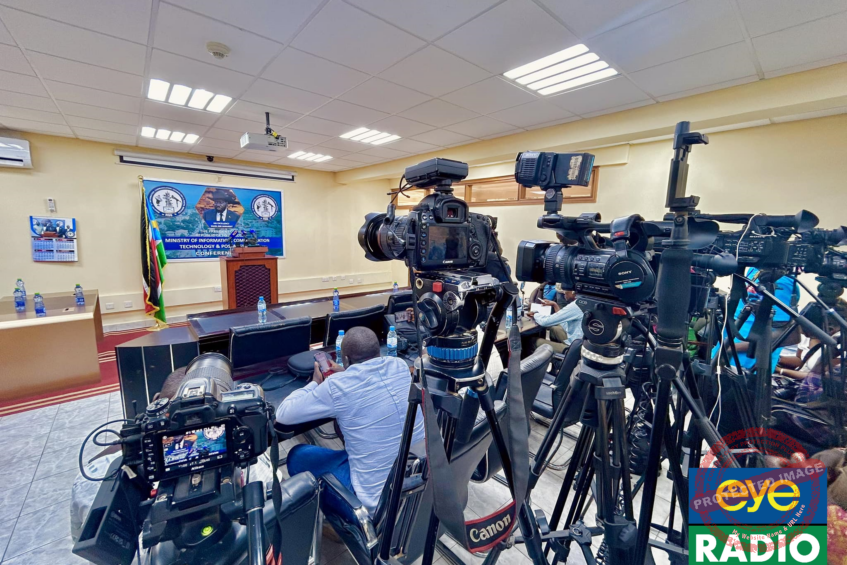
Reporters wait for a press conference by a government delegation to the Kenya-led talks at the Ministry of Information, Communication Technology and Postal Services, on Friday, July 5, 2024 📸(Lou Nelson/Eye Radio)
The President of the Union of Journalists of South Sudan (UJOSS) Patrick Oyet raised concerns about escalating threats to journalists and diminishing media press freedom in the country.
Mr. Oyet highlighted a series of recent violations against journalists and media outlets in many parts of South Sudan – with four journalists arrested between late June and July.
He said a journalist named Emmanuel Mandela was arrested by police on Thursday in Western Equatoria State while doing his job.
“We have again seen an escalation in violations of rights and shrinking civic space in the last one month or so,” Oyet stated during a dialogue on Civic Space, Media Integrity, and Elections in South Sudan.
“In Western Equatoria, just as we were about to come here, we are told that one of our colleagues has been arrested is in police custody as we speak now. We are still investigating of course what exactly happened.”
Oyet said a similar situation unfolded in Eastern Equatoria State, where a journalist working with community radio station Singaita FM was detained after airing a story about a Catholic church incident.
The story was about a statue of Biblical Mary which was broken by a woman at a church in Torit County, and her family was forced to pay for the damage.
According to Oyet, after the story was aired, church authorities surprisingly ordered the journalist’s arrest.
“A statue that is normally put in the churches was broken so the family was made to pay money and when the story went in the radio, it became an issue and that’s why the journalist was arrested.”
In Jonglei State, a journalist and photographer working with state-owned television SSBC was arrested in Bor town in connection with the peaceful demonstration in June – before he was released weeks later.
In Juba, an Eye Radio journalist was briefly detained by a Juba City Council security officer last month for covering a story related to a factory accused of polluting the environment.
The journalists union boss also highlighted the case of 10 journalists working for City Review and Al-Hagiga newspapers, who were suspended for one month after demanding a pay raise.
Oyet also pointed out that the media continues to face censorship from the National Security Service.
He explained that security officers are stationed at printing presses to review newspapers and remove articles before publication.
“We are in a period where our security officers read all newspapers before they are published and decide which articles should go out and which should not.”
As a result, newspapers often end up publishing only public relations stories, with articles related to corruption and human rights being removed.
Oyet added that some newspapers print blank pages, not because they lack content, but because articles have been censored by security officers.
“This explains why you see your papers filled mostly with PR news: ‘The government has said this, They have paid salaries for one month,’ ‘The government has done that,’ or ‘This road is going to be built.'”
“But we are not able to publish stories that talk about, for example, corruption. If someone has stolen money, where can you publish that story? It goes to the printing press, but it will not come out.”
South Sudan has dropped to 136th position on the World Press Freedom Index 2024, according to an Index by Paris-based Reporter Without Borders (RSF).
This represents a fall of 18 positions just within a year after the country was ranked at position 118 in the 2023 report.
In July, the Community Empowerment for Progress Organization (CEPO) – registered an increase in cases of violation of civic space by security agencies in different parts of the country from April to July 2024.
CEPO said its initiative dubbed Civic Space Watch observed the trend in a comparison of the incidents to those in the period from January to March, adding that the country is undergoing a challenging moment of political transitional process that requires tolerance for consultative dialogue.
Currently on air
00:00:00 - 06:00:00
 1
1Published March 3, 2026
 2
2Published February 28, 2026
 3
3Published March 1, 2026
 4
4Published March 2, 2026
 5
5Published February 27, 2026
Published 9 hours ago

Published 11 hours ago

Published 11 hours ago

Published 11 hours ago
Published 11 hours ago

Published 13 hours ago
Support Eye Radio, the first independent radio broadcaster of news, information & entertainment in South Sudan.
Make a monthly or a one off contribution.
Copyright 2026. All rights reserved. Eye Radio is a product of Eye Media Limited.