
5th April 2026
You are here: Home | National News | News | Legal threats are driving suicide cases underground -expert
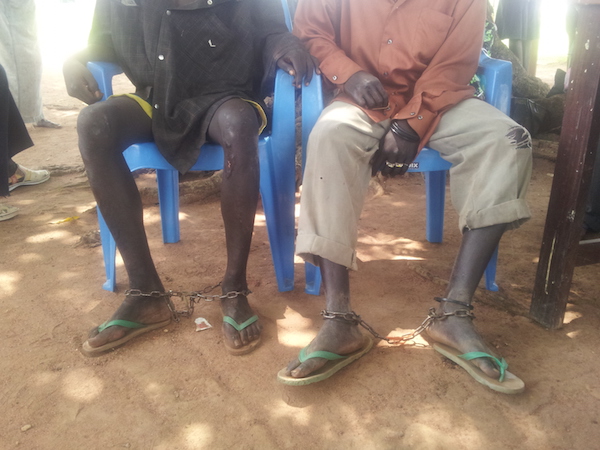
Mental health patients in one of the prisons in South Sudan. The patients are kept in prisons and always in chains - Credit- courtesy
A mental health expert has urged the government to decriminalize attempted suicide, saying this is preventing people from receiving proper care and support.
Section 215 of the South Sudan Penal Code Act of 2008, which criminalizes suicide attempts, stipulates that anyone who survives a suicide attempt can face up to one year in prison, a fine, or both
Dr. Atong Ayuel, a specialist in psychiatry, neurology, behavioral disorders, and addiction, said this is contributing to a mental health crisis.
“We consider the criminalization of suicide in South Sudan as one of the reasons that prevents people from seeking and receiving proper treatment,” said Dr. Ayuel. “Many patients are admitted under other diagnoses because most families prefer to define a suicide attempt as an accident, to avoid legal consequences.”
Her remarks follow a disturbing trend. Earlier this month, the South Sudan National Police Service reported nine suicide cases in just one week—a sharp spike that has drawn concern from both health professionals and civil society.
Police spokesperson Major General James Monday Enoka confirmed that most of the incidents occurred in Central Equatoria, Eastern Equatoria, and Lakes State.
One of the most publicized incidents happened over the weekend, when a man in his thirties attempted to take his life by jumping from a high-rise building in Juba. The event shocked residents, sparking public outcry amid a dire economic situation in the country where mental health care services are limited.
While South Sudan lacks national data on mental health prevalence, Dr. Ayuel pointed to global evidence indicating a broader crisis.
“It is difficult to determine the exact cause of the increase in mental health issues in South Sudan due to the absence of studies,” she said.
“But the World Health Organization reports that psychological disorders rise by 22% in crisis-affected settings—meaning one in every five people may be suffering. This is likely contributing to the increase in suicides.”
Edmund Yakani, Executive Director of the Community Empowerment for Progress Organization (CEPO), echoed these concerns, linking the surge in suicide to deepening economic hardship and political instability.
“A South Sudanese at Suk Sita committed suicide simply because the economic pressure made it impossible to earn a living,” Yakani said.
“This is a strong message to national leadership. The political instability is fueling an economic crisis that is triggering depression, trauma, and ultimately suicide across the country.”
Social advocates are also drawing attention to the cultural stigma surrounding mental health, especially among men.
Juma Daniel, Executive Director of Action WE Foundation, said harmful gender norms are forcing many to suffer in silence.
“There are many issues men go through, often in silence,” Daniel explained.
“In African society, men are not allowed to express their struggles. For example, at funerals, women cry, but men are expected to remain stoic. When men do show emotion, society views them as weak.”
Mental health professionals and advocacy groups are now urging the government to take immediate steps, including decriminalizing suicide, launching national awareness campaigns, and integrating mental health services into the broader public health system.
In February 2024, the former Director of Juba Central Prison raised concerns about the lack of a psychiatric hospital, which has compelled families to send 34 mentally ill persons to the prison facilities.
Lt. Gen Atok Atem Barac said the prison cannot reject the mentally ill because they are brought in with legal warrants.
He, however, adds that the mentally challenged persons are not criminals, and have been brought by their families for the sake of their safety.
General Atok said the prison is not a good place for the mentally challenged because it does not provide psychological support and medicines.
 1
1Published March 30, 2026
 2
2Published March 31, 2026
 3
3Published April 3, 2026
 4
4Published March 30, 2026
 5
5Published April 4, 2026
6Published March 30, 2026
 7
7Published March 30, 2026
 8
8Published April 2, 2026
Published 3 hours ago

Published 4 hours ago

Published 4 hours ago
Published 4 hours ago

Published 5 hours ago

Published 5 hours ago
Support Eye Radio, the first independent radio broadcaster of news, information & entertainment in South Sudan.
Make a monthly or a one off contribution.
Copyright 2026. All rights reserved. Eye Radio is a product of Eye Media Limited.