
7th September 2026
You are here: Home | Humanitarian | News | Northern Bahr el Ghazal State | ‘All the crops are dead’: Aweil East appeals for urgent drought relief

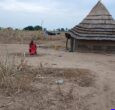
A woman sits at a home state surrounded by burnt subsistence farmland|Courtesy
Authorities in Aweil East County of Northern Bahr el Ghazal State are appealing for urgent humanitarian assistance following a prolonged dry spell that has destroyed crops, dried up water sources and left thousands of people facing food insecurity.
The dry spell has affected all seven Payams of Aweil East County, according to the Relief and Rehabilitation Commission (RRC), with local officials warning that the situation could worsen if immediate assistance is not provided.
Simon Deng bak, Minister of Cooperative and Rural Development in Northern Bahr el Ghazal State, said the drought had severely affected communities across the state.
“It is actually a severe drought that has affected Northern Bahr el Ghazal generally,” Deng Baak said while speaking in Malwalbai Payam.
“All the crops are dead and all the water has dried up,” he added, saying even water points used by communities for safe drinking water had dried up, along with rivers.
Deng Baak said the prolonged dry spell had destroyed important food crops, including groundnuts and sorghum, while vegetable production had also been badly affected.
“The population in Northern Bahr el Ghazal used to cultivate vegetables more than any state in Northern Bahr el Ghazal,” he said, warning that the drought had now affected agricultural production across the region.

The minister appealed to humanitarian and development partners, including the World Food Programme and agricultural organizations, to respond to the crisis.
“We need the World Food Programme and also agricultural organizations to come and see how the life is affected in all the areas of Northern Bahr el Ghazal,” Deng Baak said.
Aweil East County Commissioner Mawien Mawien Kuol described the situation as unprecedented. “What happened in Aweil East really, it is something very bad. It is shocking and saddening,” Kuol said.
“It is something new in the history of Aweil East, Northern Bahr el Ghazal and all. We did not expect such a dry spell like this since we were born.”
Kuol said the dry spell had created serious concerns over food, water, health and education. “My fear is that within this rain season, my people will not have food,” he said. “My people will not access clean drinking water.”
The commissioner also warned that the crisis could affect children’s access to education and healthcare as families struggle to meet their basic needs.
He said livestock were also at risk because rivers and ponds had dried up. “All rivers, ponds are empty. They are almost likely to die off because there is no rain,” Kuol said.
Kwal appealed to UN agencies, international organizations, national NGOs and other partners to intervene urgently.
“My appeal is to UN agencies, international organizations and national NGOs to quickly intervene in different aspects of human life as well as our animals,” he said.
Akot Mawic, Relief and Rehabilitation Commission coordinator for Aweil East County, said the dry spell began around the third week of June and continued through the end of August.
Mawich said 67 of the county’s 72 bomas were severely affected, while only about five were considered relatively better off.
He said the destruction of crops had left many households facing severe food shortages, with some people resorting to coping strategies to obtain food.
“Some even did not get even a one-day meal because of this hard crisis,” Mawich said. He explained that some residents were collecting water and firewood to sell in order to buy food.
The RRC coordinator said the crisis was also contributing to health problems, including childhood fever, diarrhea and acute malnutrition.
“There is a shortage of water. Food is also one of the challenges,” Mawich said. He added that returnee families were particularly vulnerable because they often depend on support from host communities, which are themselves struggling after their crops were destroyed.
“The crop that they cultivated are really damaged completely,” Mawich said. “There is no hope for the harvest for this year 2026.”
Mawich said an estimated 129,000 people had been affected by the dry spell in Aweil East County, while more than 87,000 people were reportedly facing food insecurity.
He called on the government and humanitarian partners to act urgently. “We also call on all the partners and the government to come together to see how we can support the people of Aweil East,” Mawich said.
The officials said the crisis was not limited to Malualbaai Payam , but extended across Aweil East County and other parts of Northern Bahr el Ghazal State.
Deng Baak said communities in lowland, midland and highland areas were all experiencing the effects of the prolonged lack of rainfall.
Kuol meanwhile suggested that climate change could be contributing to increasingly unpredictable weather patterns and called for longer-term measures to help communities cope with future dry spells.
“Climate change is real,” Kuol said. “In the absence of rain, we must have to develop some other mechanism to sustain our living and our livestock.”
Local authorities are now urging the government of South Sudan, UN agencies, humanitarian organizations and development partners to provide immediate assistance in food security, water and sanitation, health, education and livestock support before the situation deteriorates further.
Currently on air
09:00:00 - 12:55:00
 1
1Published September 1, 2026
 2
2Published August 31, 2026
 3
3Published August 31, 2026
 4
4Published 22 hours ago
 5
5Published September 5, 2026
 6
6Published September 5, 2026
 7
7Published September 1, 2026
 8
8Published September 4, 2026

Published 24 minutes ago
Published 27 minutes ago
Published 46 minutes ago

Published 1 hour ago

Published 1 hour ago

Published 1 hour ago
Support Eye Radio, the first independent radio broadcaster of news, information & entertainment in South Sudan.
Make a monthly or a one off contribution.
Copyright 2026. All rights reserved. Eye Radio is a product of Eye Media Limited.