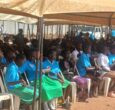
The campaign was launched on March ninth by the Ministry of General Education and Instruction, together with donors including the United Kingdom, Canada and the European Union, as well as UNICEF and other education stakeholders.
The delegation travelled to Wau to attend the launch event, inspect education and health projects, and interact with teachers, learners and health workers.
Speaking during the launch, the United Kingdom’s Ambassador to South Sudan, David Ashley, described education as the most important foundation for building a nation.
He said education shapes the strength, future and pride of a country, adding that when the foundation of education is strong, the nation itself becomes strong.
Ashley stressed that improving education requires strong government leadership, particularly in expanding access, strengthening governance and improving the quality of learning.
He said development partners remain committed to supporting South Sudan but emphasized the importance of strong partnership with the government.
The National Minister of General Education and Instruction, Doctor Kuyok Abol Kuyok, said progress is being made in some states where the number of girls enrolled in primary school has surpassed that of boys.
He cited Northern Bahr el Ghazal and Western Equatoria as examples, describing the trend as a positive development for the education sector.
Dr. Kuyok also announced that the government plans to pay capitation grants to all government primary schools this year to support school operations and learning activities.
Canada’s Ambassador to South Sudan, Joanne Minns, said education is essential for improving the lives of children, their families and communities.
She noted that donors such as Canada, the United Kingdom and the European Union have heavily invested in the education sector since before South Sudan’s independence.
However, she stressed that development partners cannot support the sector alone and called for greater investment from the Government of South Sudan.
The Deputy Head of the European Union delegation to South Sudan, Lothar Jaschke, also described the Back-to-Learning initiative as an important national campaign encouraging children to return to school.
He said development partners are proud to contribute but emphasized that managing the education system and ensuring access and quality learning remains the responsibility of the government.
Meanwhile, UNICEF Representative in South Sudan, Noala Skinner, said the campaign has gained momentum through community mobilization and public awareness efforts.
She said young advocates, radio messages and community engagement activities have been encouraging parents to send children back to school.
Skinner noted that about two point eight million children remain out of school in South Sudan and called for collective efforts to return them to the classroom.
She added that education is critical for developing skills, expanding opportunities and supporting the country’s long-term development.