
Bishop Santo demands transparency over public revenue management
JUBA — The Auxiliary Bishop of the Catholic Archdiocese of Juba, Santo Loku Pio, has questioned the government over the management and accountability of public revenues collected across the country, calling for an end to corruption and non-payment of public sector workers. Speaking at an event in Juba, Bishop Santo noted revenue collection points—including vehicle […]
Koang Pal Chang
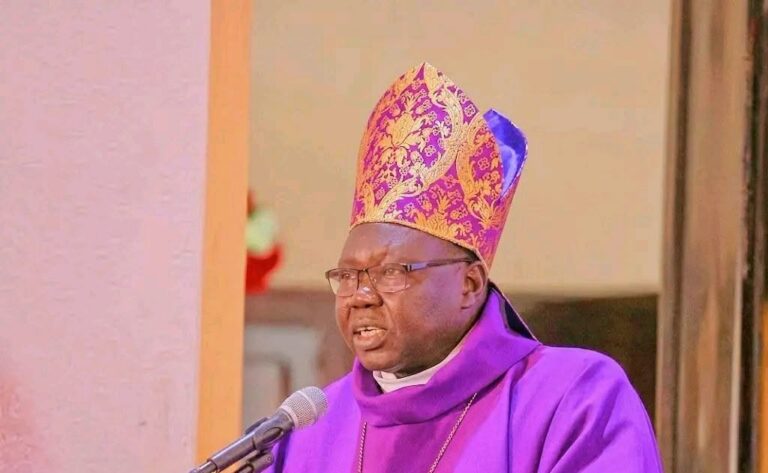
JUBA — The Auxiliary Bishop of the Catholic Archdiocese of Juba, Santo Loku Pio, has questioned the government over the management and accountability of public revenues collected across the country, calling for an end to corruption and non-payment of public sector workers.
Speaking at an event in Juba, Bishop Santo noted revenue collection points—including vehicle exit fees at Juba International Airport, border customs, markets, and natural resource extractions—stating that collections fail to reach government accounts.
Addressing government officials present at the function, the cleric urged them to convey his concerns to the national leadership to ensure public funds are audited, accounted for, and directed toward civil service salaries and public services.
Detailing his experience at the national airport, Bishop Santo raised specific concerns regarding the fee collection process.
“When my driver went and picked me from the airport as I arrived from Nairobi, while exiting the airport, you have to pay a fee,” Bishop Santo said.
“I told my driver let’s pay the fee, and on the receipt it is written the fee is between 5,000 to 7,000 SSP. What kind of official receipt is written between 5,000 to 7,000 SSP? Secondly, the person collecting the money is putting the money in his pocket—what is the guarantee that the money will reach the government?”
Bishop Santo further addressed the management of national resources and the economic impact on public servants.
“The level of corruption is now known by God, time has come when a citizen must be given his right,” Bishop Santo stated.
“The money is being collected in the market, at airport, at the border, from petroleum, from gold, and from timber, no one knows where the money is going, we are just suffering from the heat. Teachers are not paid, doctors are not paid, nurses are not paid and people are saying we have a government. We church leaders, we are holding the holy cross of this country, I would like to tell you that God will not allow innocent citizens to continue suffering like this. Nobody will forcefully take the power from them, they will run alone because all that is stolen will hang you.”
The remarks reflect public concerns regarding public sector wage arrears, anti-corruption enforcement, and state financial transparency across South Sudan.