
4th March 2026
You are here: Home | Humanitarian | News | South Sudanese refugees bear brunt of Ethiopia’s ‘breaking point’ humanitarian crisis
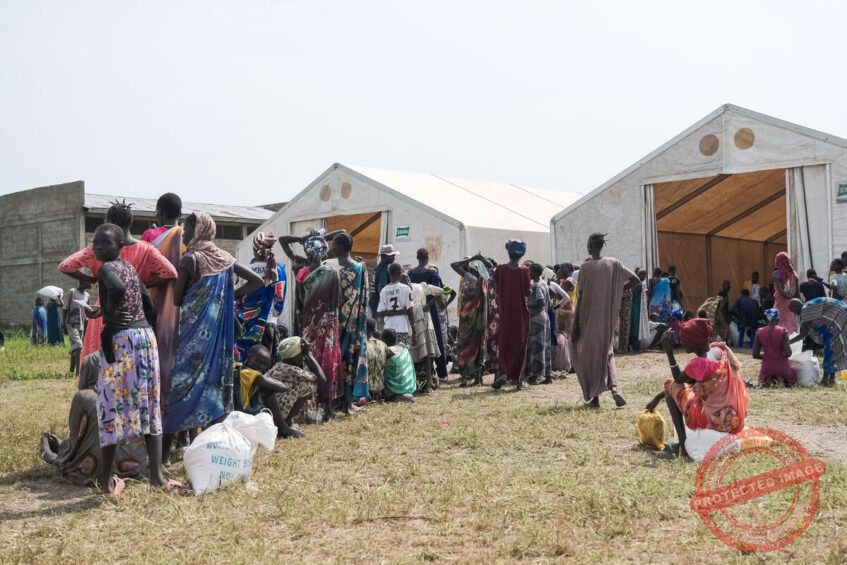
Ethiopia. Food distribution for South Sudanese refugees in Ethiopia’s Gambella Region at Yolkwuol FDP
ADDIS ABABA, Ethiopia (Eye Radio) — Nearly half a million South Sudanese refugees are facing a life-threatening halt to food, water, and healthcare as the humanitarian response in Ethiopia teeters on the edge of total collapse, according to the UN report.
UN agencies and the Ethiopian government issued a “stark warning” today, Friday, December 19, stating that the refugee response in Ethiopia is on the verge of total collapse.
It stated in a statement shared with Eye Radio that, without immediate international funding, essential services for 480,000 South Sudanese in the Gambella region and 600,000 others nationwide will cease within weeks.
With resources already exhausted, the Government of Ethiopia’s Refugees and Returnees Service (RRS), alongside UN agencies UNHCR and the World Food Programme (WFP) describe the situation as an unprecedented breaking point that threatens the survival of the region’s most vulnerable displaced populations.
Ethiopia remains the second-largest refugee-hosting country in Africa, but severe funding shortfalls have already forced aid agencies to slash emergency relief supplies by 70 percent this year.
In October, WFP was forced to cut food rations for 780,000 refugees to just 40 percent of the standard entitlement. Families are now surviving on less than 1,000 calories per day. WFP projects that these cuts will quadruple the number of families consuming poor diets and has increased the likelihood of households resorting to “negative coping mechanisms”—such as skipping meals or child labor—by 66 percent.
“Our resources are stretched to the limit, and the pressure on host communities is becoming unbearable,” said Ms. Teyiba Hassen, Director General of RRS. “Immediate international support is a must to avoid a humanitarian catastrophe.”
The human cost of the shortfall is already being felt in camp clinics. Malnutrition rates have exceeded the 15 percent emergency threshold, and admissions for malnutrition have doubled compared to last year. Most tragically, the mortality rate for newborns and children under one year rose to 4.7 percent in 2025.
According to UNHCR, the crisis extends far beyond food; the refugees receive an average of only 12–14 liters of water per day, with some areas dropping to just five liters—far below the 15-liter emergency standard.
On education, the funding for 57 primary schools serving 110,000 children has been exhausted. These schools are scheduled to close on December 31, 2025, leaving teachers unpaid and children at risk of trafficking and early marriage.
The agencies are urgently calling for US$90 million to sustain operations for the next six months.
“We have reached a critical moment where the choice we make now will determine whether Ethiopia’s refugee response collapses or becomes a model for resilience,” said Ms. Aissatou M. Ndiaye, UNHCR Country Representative.
While Ethiopia has honored its commitments to keep its doors open to those fleeing conflict in Sudan and South Sudan, the government and UN agencies insist that the international community must now share the burden to prevent the loss of an entire generation.

Currently on air
00:00:00 - 06:00:00
 1
1Published March 3, 2026
 2
2Published February 28, 2026
 3
3Published March 1, 2026
 4
4Published March 2, 2026
 5
5Published February 27, 2026
Published 7 hours ago

Published 8 hours ago

Published 9 hours ago

Published 9 hours ago

Published 9 hours ago

Published 11 hours ago
Support Eye Radio, the first independent radio broadcaster of news, information & entertainment in South Sudan.
Make a monthly or a one off contribution.
Copyright 2026. All rights reserved. Eye Radio is a product of Eye Media Limited.